



Engineers from Princeton University have developed a new generation of soft robots capable of moving using only heat, without the need for motors or bulky external systems.
This advancement marks a milestone in soft robotics, a field with great potential for applications in medicine, exploration of hazardous environments, and high-precision tasks.
Technology Behind the Movement
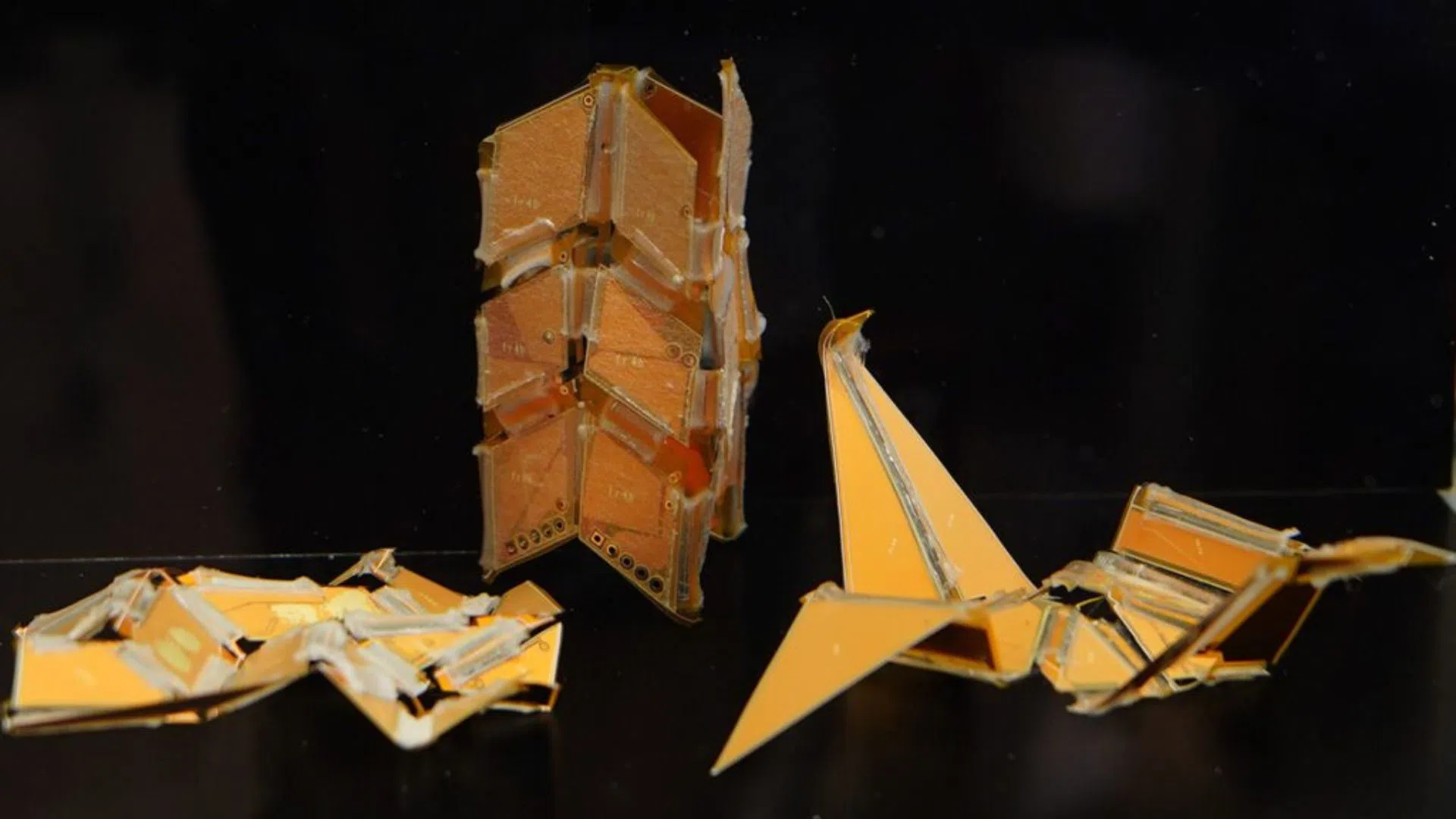
The secret lies in a liquid crystal elastomer, a polymer whose molecular structure can be programmed to respond to heat. By printing the material with a controlled molecular alignment, zones are created that function as flexible hinges. When these are heated, they bend predictably, allowing the robot to fold and unfold according to the task.
During printing, engineers integrated flexible circuit boards into the robot’s body, eliminating assembly steps and improving reliability. These circuits allow specific regions to be heated with great precision and feature temperature sensors that provide real-time feedback, correcting deviations during repeated movements.
Inspiration from Origami
The design was based on mathematical models of origami, in collaboration with expert Glaucio Paulino. As a demonstration, the team built a crane-shaped robot capable of flapping its wings by applying electricity and performing repeated movements without visible wear.
Integration of Materials and Electronics
The initiative began as the thesis of David Bershadsky, who sought an efficient way to create robotic units capable of changing shape through volume control. Along with professors Davidson and Paulino, he also developed a software tool that allows other researchers to design similar robots, available along with the study data.
Bershadsky highlighted that the biggest challenge was the integration of very different technologies: smart materials, flexible electronics, and thermal control. Overcoming this difficulty allowed the robot to function as a coherent unit, without relying on traditional mechanical assemblies.
Potential Applications
This approach opens the door to more autonomous, lightweight, and versatile soft robots capable of operating in:
- Minimally invasive surgeries, where precision and flexibility are essential.
- Exploration of inaccessible environments, such as contaminated areas or confined spaces.
- Adaptive smart devices, capable of changing shape according to the task.
The ability to control movement through heat and integrated electronics could enable scalable manufacturing of soft robots to operate inside the human body or in extreme environments.
The advancement achieved by Princeton represents a step towards a new generation of soft robots that do not rely on conventional motors. Their design combines innovation in materials, integrated electronics, and thermal control, offering practical solutions for medical, industrial, and scientific challenges. This development opens the door to a future where soft robots are protagonists in advanced surgery, remote exploration, and smart technology.



