



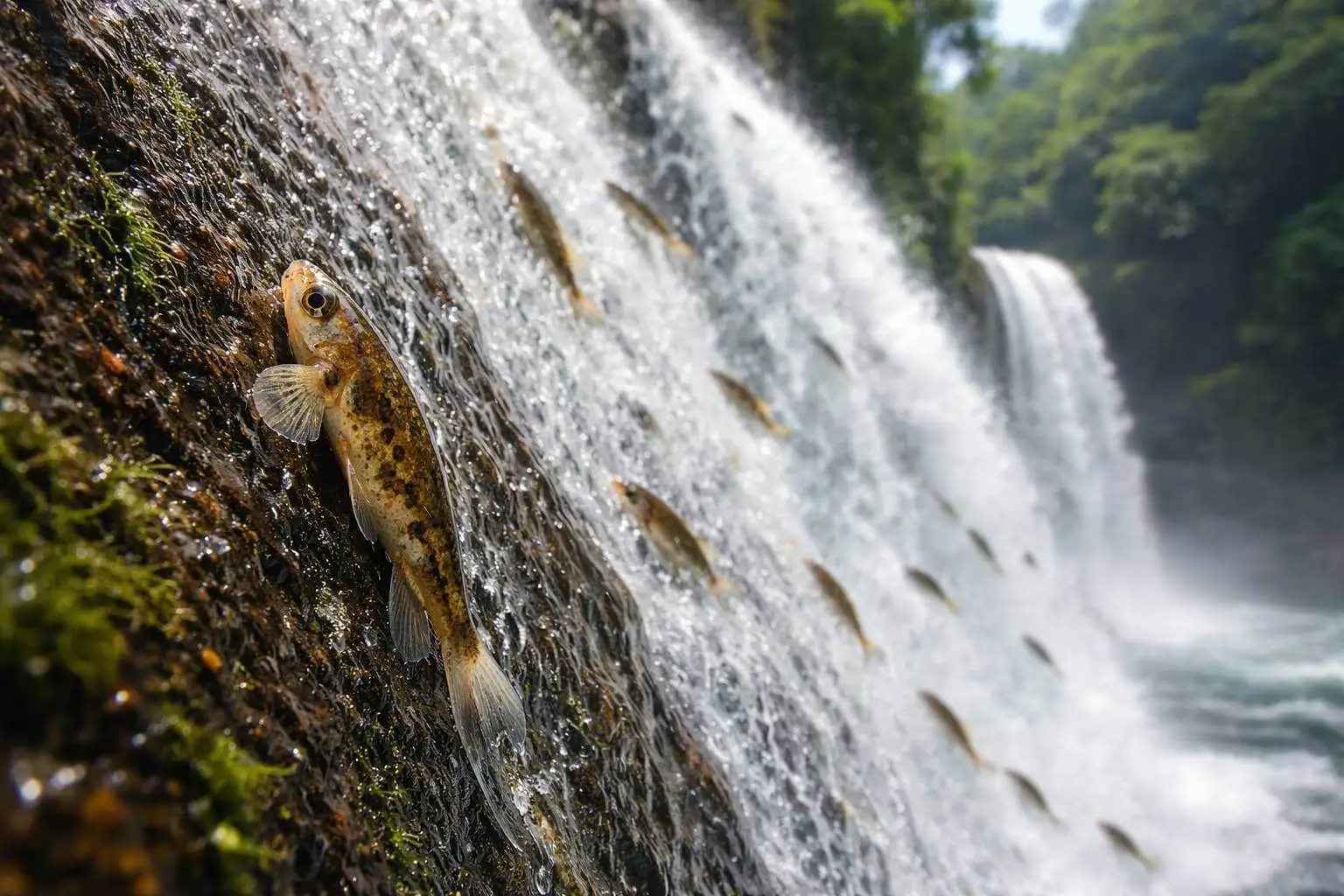
In the Democratic Republic of the Congo, researchers documented for the first time a surprising phenomenon. The tiny fish Parakneria thysi, locally known as shellear or shell ear fish, is capable of climbing waterfalls up to 15 meters high.
The finding, published in Scientific Reports, constitutes a global milestone in the study of fish behavior.
The discovery was led by biologist Pacifique Kiwele Mutambala from the University of Lubumbashi, who, along with his team, observed between 2018 and 2020 how thousands of specimens slowly ascended the wet rocks of the Luvilombo Falls during the rainy season.
The Climbing Feat
The fish, measuring between 37 and 48 millimeters (though they can reach up to 10 cm), manage to climb thanks to their hook-shaped pectoral and pelvic fins, which allow them to adhere to the vertical surface. The constant spray from the waterfall keeps the walls wet, a necessary condition for them to advance.
The complete ascent can last almost 10 hours, with continuous pauses to regain energy. To cover one meter of height, they require between 30 and 60 seconds, interspersed with breaks. In total, the researchers calculated that a fish needs 9 hours and 45 minutes to overcome the entire waterfall, stopping at least nine horizontal ledges.
Not all manage to reach the top: the slow movement and inverted ledges cause many specimens to fall behind or be swept away by water surges.
Risks and Threats
The study warns about the threats faced by the species:
- Illegal fishing: the congregation prior to climbing facilitates capture using prohibited nets with mesh smaller than five centimeters.
- Water diversion: during the dry season, the Luvilombo River is channeled to irrigate crops in the village of Sangala, which can dry up entire sections and restrict migration.
These practices endanger the continuity of a unique evolutionary behavior.
Conservation and Ecotourism
Mutambala’s team emphasizes the need for urgent protection measures to preserve this phenomenon. Promoting responsible ecotourism activities could contribute to the conservation of the shellear habitats and raise awareness about the threats derived from human actions.
“This discovery highlights the importance of maintaining the continuity of watercourses, especially in the Congo, where studies on fish behavior are practically nonexistent,” noted Pacifique Kiwele.
The finding of Parakneria thysi climbing waterfalls in the Congo reveals an extraordinary evolutionary adaptation, never before documented in fish. Its protection is vital to ensure the survival of this endemic species and to preserve a unique example of nature’s ability to challenge the limits of what is possible.


