



Peru advances in an unprecedented environmental strategy to preserve one of its most valuable ecosystems. Through the Consortium of Mangroves of Northwestern Peru, the country launched the first blue carbon project aimed at conserving the Los Manglares de Tumbes National Sanctuary.
The proposal combines environmental conservation, climate financing, and ecological restoration. Additionally, it seeks to transform the protection of mangroves into a sustainable tool capable of generating resources to maintain the ecosystem in the long term.
In this context, specialists began to measure the carbon stored in the coastal forests of Tumbes, considered essential for reducing greenhouse gases and protecting marine and terrestrial biodiversity.

The mangroves of Tumbes, a natural barrier against the climate crisis
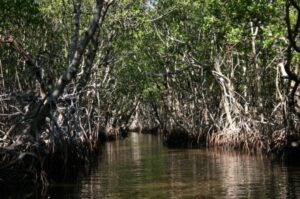
Mangroves perform essential functions for environmental balance. Their roots retain sediments, cushion floods, and serve as a refuge for fish, crustaceans, and birds that depend on these environments to survive.
Additionally, the Los Manglares de Tumbes National Sanctuary functions as a huge natural carbon reservoir. Preliminary studies conducted in 2023 revealed that the ecosystem stores approximately 450 tons of carbon per hectare between biomass and soil.
In total, it is estimated that the mangroves of the region conserve about 1.78 million tons of carbon, equivalent to more than 6.5 million tons of carbon dioxide kept out of the atmosphere.
Moreover, specialists emphasize that degraded forests have a great potential for restoration. While mature mangroves maintain stable capture, recovering areas can absorb carbon at a faster rate.
What is blue carbon and how does it help the environment?
Blue carbon is the carbon captured and stored by coastal ecosystems with vegetation, such as mangroves, marshes, and seagrasses. These environments have an enormous capacity to absorb carbon dioxide and retain it for centuries in roots and sediments.
Unlike other terrestrial ecosystems, mangroves store large amounts of carbon underwater and in waterlogged soils. This significantly reduces the release of greenhouse gases responsible for global warming.
Moreover, blue carbon helps protect coasts against storms, erosion, and rising sea levels. It also promotes marine biodiversity and strengthens economic activities linked to artisanal fishing and sustainable tourism.
Consequently, numerous countries have begun to incorporate these ecosystems into their climate strategies. The conservation of mangroves is already considered a key tool to face the global environmental crisis.
An innovative project facing technical and economic challenges
The Peruvian project began in 2023 the process of international certification under the Plan Vivo standard. This step would allow entry into the voluntary carbon market and attract investments aimed at conservation and ecological restoration.
However, significant obstacles still persist. The Ministry of Environment of Peru must still officially recognize the initiative within the National Registry of Mitigation Measures, a necessary condition to advance to new stages.
Furthermore, specialists are analyzing expanding the project’s scope to the entire mangrove ecosystem and not just the protected sanctuary. The expansion would increase the carbon capture capacity and strengthen the environmental impact of the proposal.
Thus, Peru attempts to consolidate a model where nature protection and climate financing work together to preserve one of the most fragile and strategic ecosystems in South America.



