



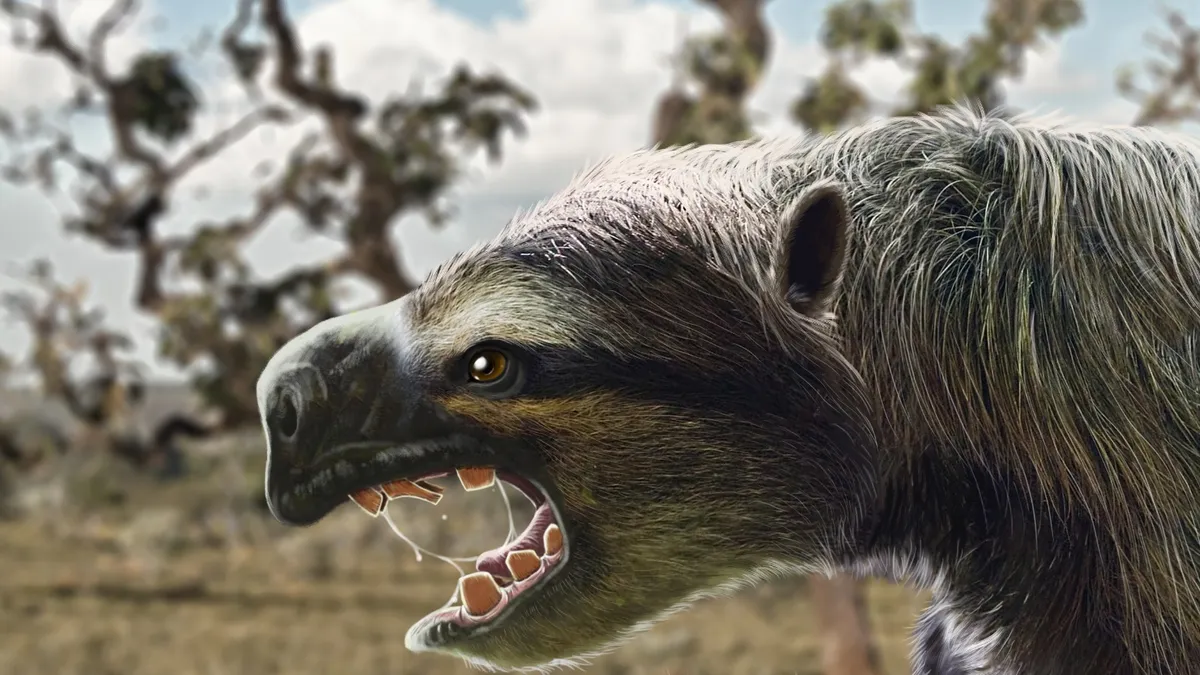
An international team of scientists, including researchers from the CONICET, described Ocnotherium giganteum, one of the largest giant sloths known to date.
The study, published in the Zoological Journal of the Linnean Society, provides about 90% of the animal’s skeleton and concludes an investigation that began in the 19th century, when only three teeth of this species had been found in Brazil.
Context and relevance
The discovery was made in the caves of Toca dos Ossos, Toca das Onças, and Brejões, in Bahia and Minas Gerais, completing decades of research initiated by Castor Cartelle.
The description of this new species expands knowledge about the South American megafauna, especially in tropical regions where fossil records were scarce.
Anatomical characteristics
- Robust skull and unique dentition, different from other giant sloths like Glossotherium, Mylodon, or Lestodon.
- Approximately 50 vertebrae, with a body adapted for mobility.
- Prehensile five-fingered hand, which provided great manipulation capability.
- Robust and curved hind limb, with feet twisted inward.
- Developed olfactory bulbs, suggesting a highly efficient sense of smell.
- Pneumatized skull, an adaptation to reduce weight and facilitate movement.
- Osteoderms in the skin, small bony plates that reinforced its body.
Its approximate mass was two tons, making it one of the largest sloths recorded in Brazil.
Paleobiology and lifestyle
The study suggests that Ocnotherium giganteum primarily moved on four legs, although it could adopt bipedal postures occasionally. Its small inner ear did not imply reduced hearing, and its olfactory capability would have been key to detecting food and predators.
Phylogeny and endemism
The phylogenetic analysis places it within the mylodontines, with convergent traits with the lestodontines. It is an endemic species of the Atlantic coast of Brazil, the ninth recorded in the country during the Pleistocene.
Interaction with humans
A relevant aspect of the study is the evidence of interaction with the first Homo sapiens. An analyzed humerus shows marks of anthropic origin suggesting butchering, indicating it may have been hunted or scavenged and was part of the human diet about 12,000 years ago.
The discovery of Ocnotherium giganteum not only solves a nearly 200-year-old paleontological enigma but also provides key information about the diversity and adaptation of South American megafauna. This finding reinforces the importance of Brazil as a fundamental territory for understanding the evolution and extinction of large mammals of the Pleistocene.

