



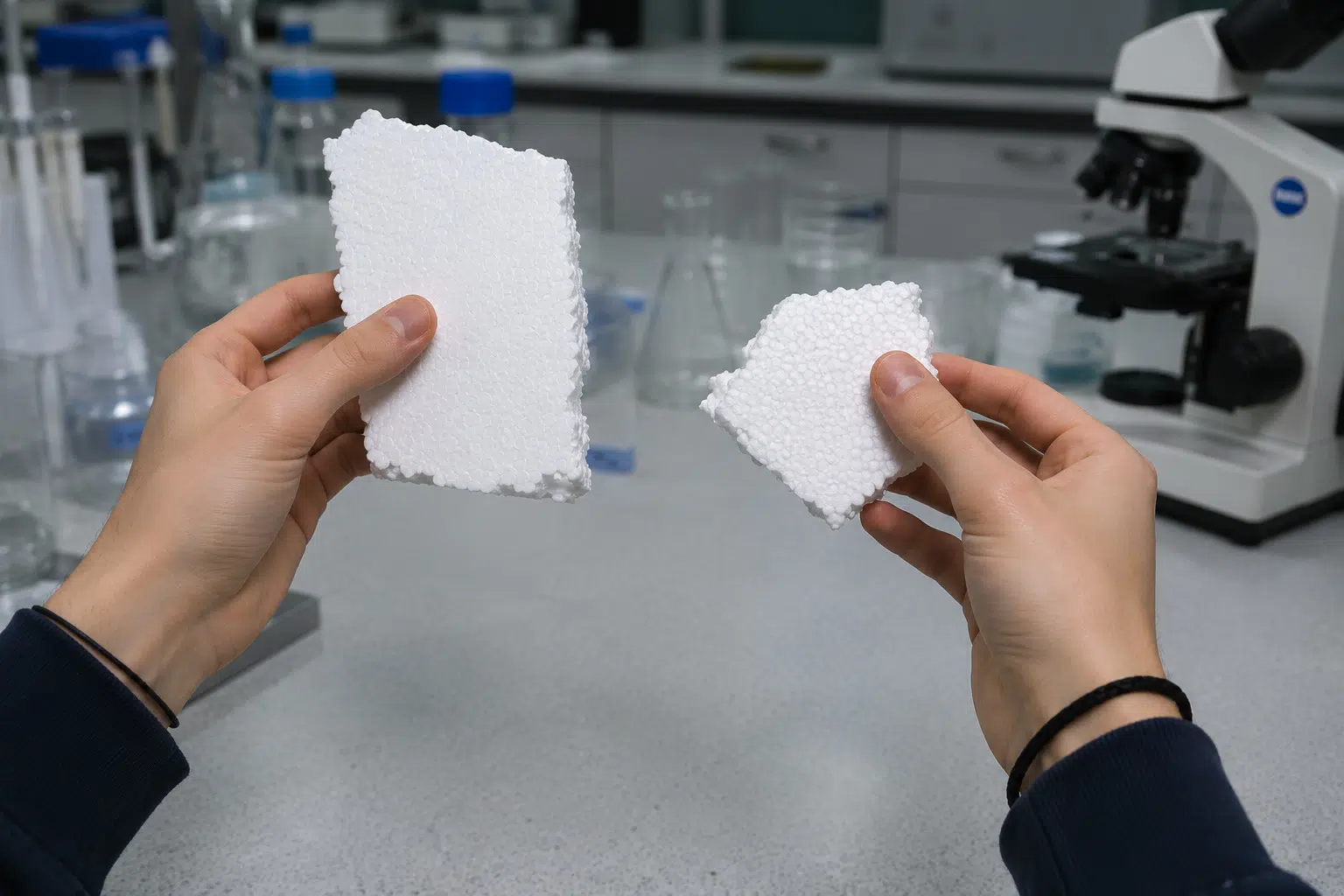
Expanded polystyrene (styrofoam) is one of the most difficult materials to recycle. Found in packaging, disposable cups, and packing materials, it is composed of 95% air and only 5% plastic, making it an excellent insulator but a persistent waste that is recycled in only 1% of cases in the United States. The rest ends up accumulating in landfills, rivers, and oceans, where it can remain for centuries.
In response to this problem, Emily Miner, a 13-year-old student from California, developed with her team Nano Nerds a machine capable of using bacteria to degrade styrofoam and transform it into biodegradable bioplastic and energy.
The Scientific Discovery
During the research, the students identified the bacterium Pseudomonas putida, known for its ability to metabolize styrene, the base compound of polystyrene. Leveraging this natural metabolism, they designed a system that allows microorganisms to degrade the material and generate two main products:
- PHA: a biodegradable bioplastic used in packaging and industrial applications.
- Heat: produced by the metabolic activity of the bacteria, with potential to generate energy.
The invention was named Polystyrenator, a closed digester that maintains the ideal conditions for the bacteria to perform their work.
School Innovation with Global Impact
The project was presented at the First Lego League, an international competition that challenges students to solve real-world problems through science and engineering. Among thousands of teams, the Nano Nerds managed to rank among the 20 semifinalists of the Global Innovation Award, which attracted the attention of specialists in waste management and sustainability.
This recognition allowed the initiative to transcend the school environment and become an example of how youthful creativity can provide solutions to complex environmental challenges.
Circular Economy and Sustainability
The PHA produced by the system is considered much more environmentally friendly than conventional plastics. Unlike styrofoam, which can remain intact for centuries, PHA degrades in much shorter periods under suitable conditions.
Therefore, specialists highlight that this type of material could play a key role in the development of circular economy models, where waste is transformed back into useful resources.
Obstacles and Next Steps
Although the project demonstrated that the biological degradation of polystyrene is possible, challenges remain:
- Scalability: currently, about 14 million tons of styrofoam are produced per year worldwide, while biological solutions are still in the experimental phase.
- Economic Viability: proving that the system can process large volumes of waste profitably.
- Infrastructure: the need for plants capable of integrating this type of digester at an industrial level.
The Polystyrenator by Emily Miner and her team Nano Nerds is an inspiring example of how science, microbiology, and technological innovation can come together to tackle one of the planet’s most problematic wastes.
Although there is still a way to go to implement this technology on a large scale, the initiative demonstrates that even an idea born in a school setting can open new possibilities for the future of recycling and sustainability.


