



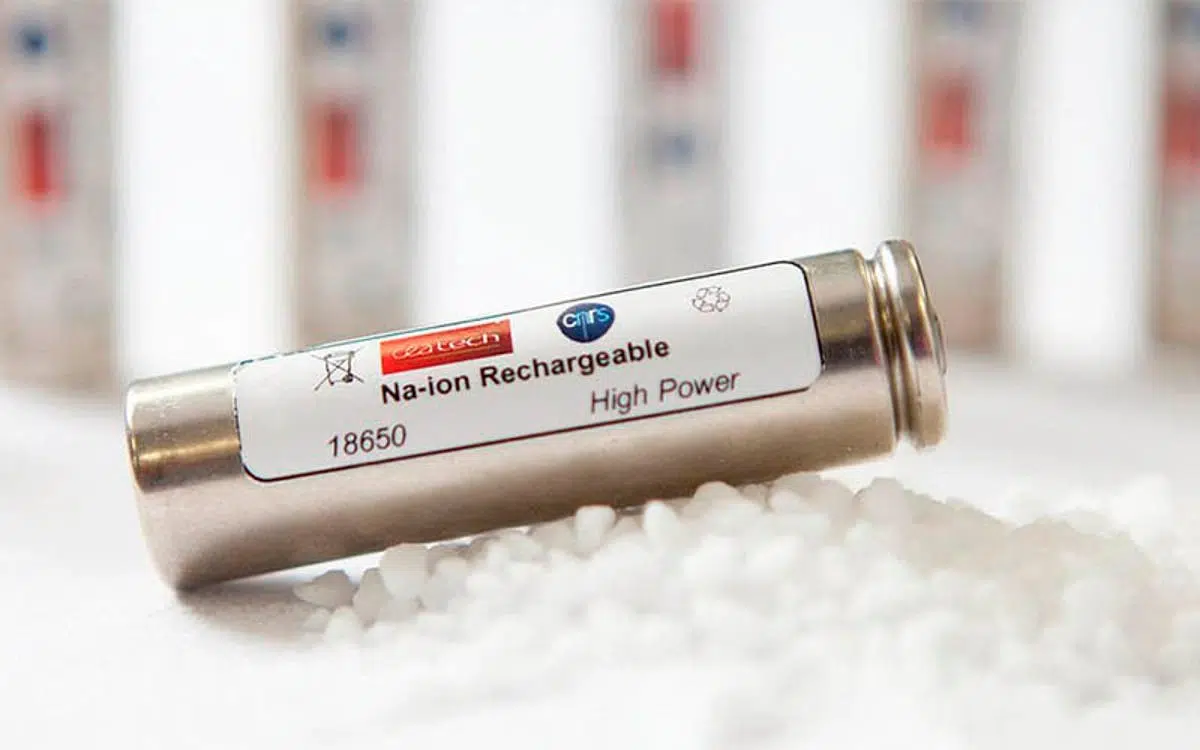
Investigators from the University of the Southeast, in collaboration with HiNa Battery Technology and the Yangzhou University, achieved a key breakthrough in the development of metallic sodium batteries. This new technology promises to become a cheaper and more accessible alternative to current lithium batteries, thanks to the abundance of sodium as a resource.
The created battery charges in just 4 minutes, operated for 6,000 hours without failure, supports 2,000 cycles, and maintains very low costs.
The Challenge of Sodium Batteries
Until now, these batteries faced two main obstacles:
- Slow ionic conduction.
- Instability due to dendrites, structures that cause short circuits.
The new design overcomes both problems thanks to a quasi-solid dual mediator electrolyte, which combines tin ions and difluoro (oxalato) borate (DFOB⁻) anions.
How the New Electrolyte Works
- The DFOB⁻ weaken the interactions between sodium ions and the polymer network, releasing more ions and increasing the diffusion rate up to six times compared to traditional liquid electrolytes.
- The tin ions form a sodium-tin rich interface on the anode, promoting an even distribution of the metal.
- On the cathode, the DFOB⁻ generate a protective layer that reduces electrolyte degradation.
This design improves stability, minimizes polarization, and increases reliability.
Laboratory Results
The tests were exceptional:
- Operation for 6,000 hours without dendrite failures.
- Support for critical densities of up to 3.0 mA cm⁻².
- Capacity of 80.1 mAh g⁻¹ even with ultra-fast charging.
- Retention of 90% capacity after 2,000 cycles at a high charge rate.
Additionally, pouch cells were manufactured without pressure and continued to function even after being repeatedly bent, demonstrating mechanical resistance and the ability to power devices like smartphones.
Strategic Impact for China
The development of these batteries is part of China’s strategy to lead the energy transition and consolidate its dominance in the electric vehicle industry:
- Technological and productive monopoly: controls nearly three-quarters of the world’s battery production.
- Geopolitical and commercial influence: surpassed Japan as the largest car exporter, expanding its industrial power in regions like Latin America.
- Internal economic advantage: cheaper mobility thanks to low electricity costs and subsidy policies.
- Environmental and health impact: reduction of urban pollution and thousands of premature deaths avoided in major metropolises.
The new metallic sodium battery represents a decisive advance towards a more secure, economical, and sustainable energy future. Its ultra-fast charging capability, prolonged stability, and low cost make it a real alternative to lithium, with applications ranging from electric vehicles to stationary storage systems.


