



A study published in Frontiers in Insect Science demonstrates how certain species of leaf-cutting ants evolved about 15 million years ago to adapt to environmental changes in South America.
The reduction of forested areas and the expansion of grasslands and savannas led them to develop shorter and more robust mandibles, capable of cutting silica-rich grasses, a resource difficult to process but abundant in these new landscapes.
Study Methodology
The research team, composed of specialists from the Foundation for the Study of Invasive Species (FuEDEI) and CONICET, analyzed DNA from ants of the genera Acromyrmex, Amoimyrmex, and Atta collected in Argentina, Uruguay, Paraguay, and Brazil.
Through statistical models and genetic comparisons, they managed to reconstruct the evolutionary history of these insects and confirm that their ancestors primarily cut dicotyledons before specializing in grasses.
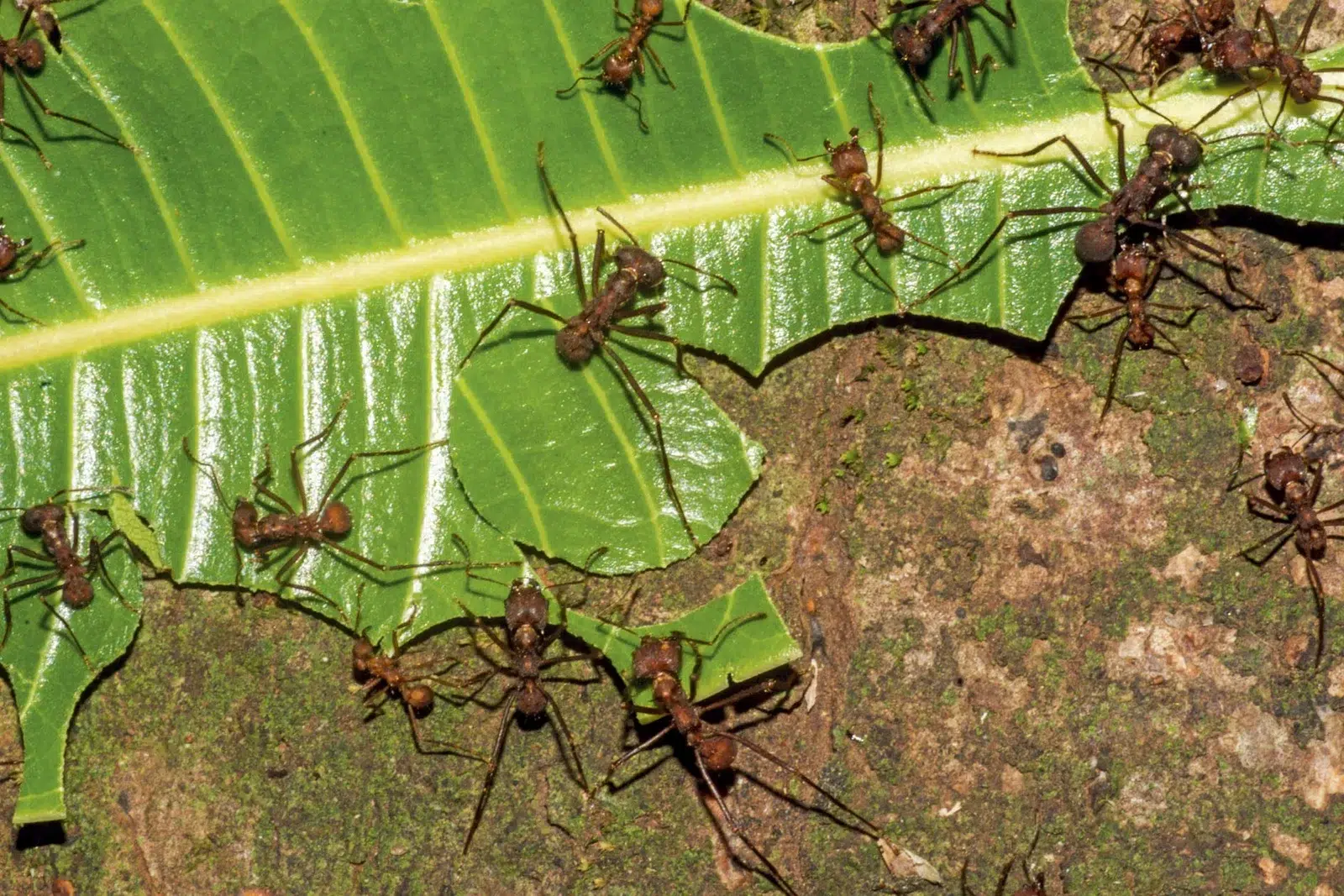
Adaptation to the New Environment
Reinforced mandibles: optimized for cutting hard and narrow leaves.
Use of grass as a substrate: they do not consume it directly but use it to cultivate a specific fungus that feeds larvae and adults.
Dome-shaped nests: maintain a stable temperature (24 °C) for fungus growth.
Symbiotic associations: bacteria and cleaning behaviors that protect the crop from pathogens.
Ecological and Productive Impact
Leaf-cutting ants play a fundamental ecological role by removing nutrients from the soil and maintaining ecosystem dynamics. However, some species generate agricultural impacts:
- They can damage vineyards and young forest plantations.
- If controls are not applied, economic losses can be very large.
- Chemical methods are the most used, although more sustainable alternatives are being sought.
Evolutionary Perspective
Biologist Andrés Sánchez-Restrepo, coordinator of the molecular area of FuEDEI, explained that the expansion of grasslands during the Miocene was an opportunity for ants to exploit a previously unexplored resource. “Understanding how some came to cut grasses helps us design more efficient and specific control strategies,” he noted.
The study also highlights that, despite their adaptability, these ants are not good colonizers outside of South America. The Andes Mountains act as a natural barrier, preventing their expansion into Chile and the coast of Peru.
Leaf-cutting ants have been perfecting their agricultural system for over 15 million years, long before humans.
Their evolution towards grass cutting reveals how environmental changes shape the biology of species and offers clues to address the challenges they pose in agriculture and forestry.



