



An international team of scientists confirmed the existence of the largest known fish breeding colony on the planet under the Filchner ice shelf, in the Weddell Sea (Antarctica).
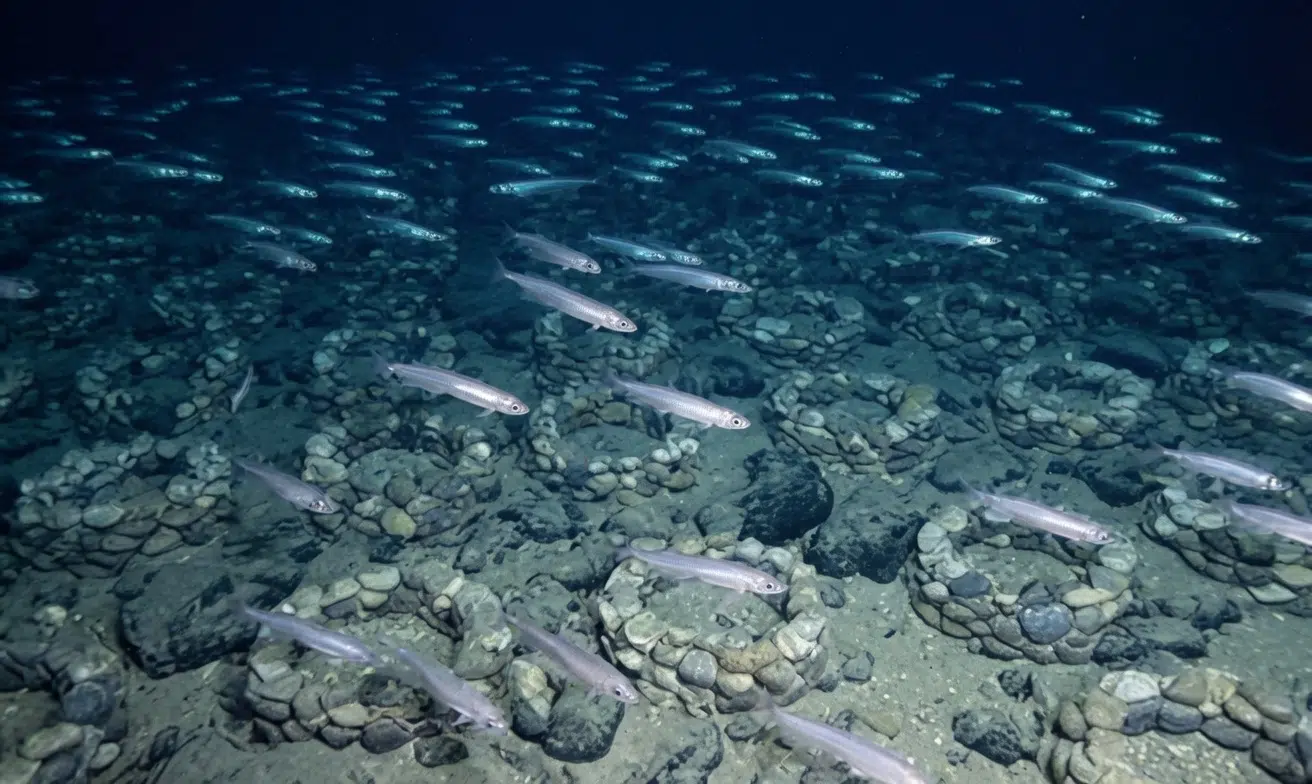
The discovery reveals a hidden ecosystem formed by 60 million icefish nests spread over approximately 240 km², an area similar to the city of Orlando in the United States.
Exploration Technology
The colony was detected in 2021 by the Alfred Wegener Institute (AWI), led by Autun Purser, using the Ocean Floor Observation and Bathymetry System (OFOBS).
Subsequently, the autonomous vehicle LASSIE was deployed, capable of operating under hundreds of meters of ice for 48 hours. This robot confirmed the extent and density of the nests, providing unprecedented data on the ecosystem’s stability.
The Blackfin Icefish
The protagonists of this “underwater city” are the icefish (Neopagetopsis ionah), a species with extraordinary adaptations:
- They lack hemoglobin, which makes their blood transparent.
- They produce antifreeze glycoproteins that prevent ice crystal formation in their bodies.
- They build circular nests about 75 cm in diameter, where they lay around 1,700 eggs.
- Males guard the clutch until hatching, ensuring the offspring’s survival.
The nest density averages 0.26 per square meter, forming a massive reproductive network that extends as far as the robot’s cameras can reach.
Unique Environmental Conditions
Scientists discovered that a slightly warmer deep current flows through the Filchner Trench, raising the water temperature in that area up to 2 °C above the surrounding waters.
This difference, although minimal, creates the ideal conditions for icefish reproduction.
Predators and Ecological Balance
The colony also attracts predators such as Weddell seals, which regularly visit during the breeding season to feed on adult fish.
This phenomenon makes the nursery a key point of ecological interaction in the Weddell Sea.
Implications for Conservation
The finding reinforces the need to expand Marine Protected Areas in the region. Continuous monitoring through autonomous vehicles will allow the evaluation of these populations’ evolution in the coming decades and ensure the protection of a unique ecosystem on the planet.
The “underwater city” of fish beneath the Filchner shelf represents an unprecedented discovery in Antarctic marine biodiversity.
This finding not only reveals the icefish’s adaptability but also highlights the importance of protecting hidden ecosystems that play vital roles in the balance of the Southern Ocean.



