



Thirteen hatchlings of giant tortoise from Aldabra were born in the Seychelles islands following the first successful artificial incubation of this threatened species.
The achievement, the result of an innovative conservation project, represents a significant advancement in protecting one of the planet’s largest and longest-living reptiles, our beloved giant tortoises.
The hatchlings come from 18 eggs recovered by conservationists in a nest located on Cousin Island, part of the Seychelles archipelago.
A week after hatching, the small tortoises are being fed with slices of banana and leafy greens while regaining strength under protection, giving hope to the giant tortoise population.
Giant tortoises in Seychelles: an advancement for conservation
“It’s a great advancement”, stated Alessia Lavigne, a Seychellois researcher from the University of Sheffield in England and the lead author of the study.
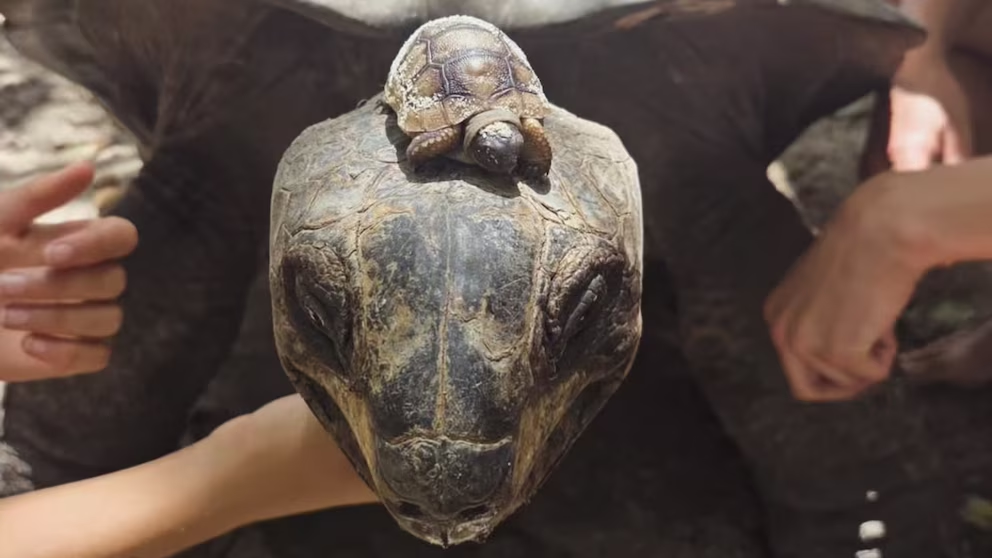
“It demonstrates what conservation can achieve,” she added, referring to the reproductive success achieved in her project with five tortoise species, highlighting the positive impact on these giant tortoises.
Scientists employed an innovative technique to determine which undeveloped eggs were fertilized and had development potential.
The study revealed that 75% of the undeveloped eggs had been fertilized, but the embryos died during an early stage.
The problem of low natural incubation of giant tortoises
These results explain the low incubation success of the Aldabra giant tortoise in wild nests.
According to the International Union for Conservation of Nature (IUCN), the problem is attributed to environmental issues rather than genetic factors.
The low number of hatchling sightings in wild areas suggests limited reproductive rates in many of the islands where giant tortoises inhabit.
The incubation of fertilized eggs can help bolster numbers in case of crisis. This, according to the project, was developed in collaboration with Nature Seychelles and other local conservation organizations.
The survival story of tortoises and their threats
The giant tortoises suffered annihilation in most of the Indian Ocean islands in the 19th century. The cause was hunting campaigns driven by sailors.
The population of the Aldabra islands group survived by being isolated from the rest of the ocean, establishing a safe haven for these giant tortoises.

This biological uniqueness, along with more than 400 endemic species and the characteristic landscape, led to the Aldabra atoll being declared a World Heritage Site by UNESCO in 1982.
With the aim of providing a safety net for the species against potential future threats, various specimens were relocated to other islands. Among them Cousin, in an attempt to expand the giant tortoise populations.
This is especially relevant in the context of tourism development observed on at least one island, funded by investment from Qatar.
Science calls for another long-term solution
Nicola Hemmings, from the Department of Biosciences at the University of Sheffield, considered it “wonderful that it has been demonstrated that these eggs are viable.”
However, she emphasized that “artificial incubation is not a long-term solution” for giant tortoises.
Now, the researcher proposes the next step: “We need to identify the variables affecting survival in the natural nest environment. Additionally, see if there are ways to improve them.”
The research team plans to share the results with the scientific community of the Galapagos Islands. This is the only other place where a similar species of giant tortoise survives.
The Aldabra giant tortoise can exceed 250 kilograms and reach a lifespan of over a century and is part of the group of surviving giant tortoises.



