



The government of Nova Scotia, Canada, approved a 20-year lease to build the country’s first coastal whale sanctuary. This space, one hundred times larger than the tanks at Marineland of Canada, will be a refuge where belugas can swim freely in safe ocean waters.
The project, led by the Whale Sanctuary Project, seeks to transform a natural cove into a permanent home for rescued cetaceans. Although it has not yet been confirmed which species will be relocated, it offers concrete hope for the 30 belugas that remain in Marineland after years of confinement.
In their natural habitat, belugas live up to 60 years, travel thousands of kilometers, and maintain complex social networks. In captivity, these behaviors disappear. Therefore, sanctuaries represent an ethical transition towards a more compassionate coexistence with marine animals.
The announcement comes after the decision by Canada’s Department of Fisheries and Oceans to block the transfer of the belugas from Marineland to a marine park in China. The measure complies with the law that prohibits the captivity of cetaceans for recreational purposes and prevents them from being exploited in shows.
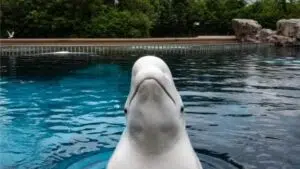
Marineland of Canada: a park in decline
In recent years, Marineland has become a symbol of animal cruelty. Since 2019, at least 19 belugas have died, in addition to dolphins, seals, and an orca. The causes range from internal aggression to failures in water quality, according to official reports.
In 2023, Sonar, a bottlenose dolphin, and Kodiak, a beluga captured in Russia, died. Both had spent more than two decades in tiny tanks. Shortly before, the orca Kiska, the last in captivity in Canada, died from a bacterial infection.
This is compounded by two more deaths in 2024 due to gastric torsion, a condition related to stress. In total, 26 animals died in just six years, highlighting the consequences of keeping marine mammals in artificial spaces without natural stimuli.
The impact of confinement
Belugas and dolphins are highly social beings that depend on communication, movement, and cooperation. In marine parks, their life is reduced to swimming in circles, without challenges or real bonds. This generates chronic stress, aggression, and diseases.
Confinement alters their natural behavior and affects their physical and emotional health. In the wild, these animals form extensive family groups and collectively care for their young. In captivity, that structure is destroyed.
Coastal sanctuaries offer a viable and ethical alternative: large spaces where they can regain some of their autonomy, remain under human care, and live without exploitation. They represent a new form of environmental and moral repair.

A future free from exploitation
Since 2019, Canada has prohibited keeping cetaceans in captivity for entertainment purposes. This policy seeks to prevent new cases like Marineland and promote the rehabilitation of the remaining animals. In contrast, parks in the U.S., such as SeaWorld, still keep dolphins and orcas in shows.
The Nova Scotia sanctuary symbolizes a global change. It not only protects the surviving whales but also demonstrates that it is possible to replace animal entertainment with responsible conservation and environmental education.
As ecological awareness grows, coastal sanctuaries could become emblematic refuges, where marine species regain some of the freedom that was taken from them.
Conservation status of belugas and other cetaceans
The belugas (Delphinapterus leucas) are classified as “near threatened” by the IUCN. Their global population is around 200,000 individuals, but some subpopulations, such as those in the St. Lawrence Estuary, are in critical danger due to pollution and maritime traffic.
Climate change also affects their Arctic habitats, reducing the sea ice they use for movement and communication. Additionally, oil spills and underwater noise disrupt their migratory routes and echolocation ability.
Other cetaceans, such as orcas and bottlenose dolphins, also face similar risks. Chemical pollution, plastics, and aggressive tourism worsen their situation. Coastal sanctuaries, therefore, not only free animals from captivity, but also project as active conservation tools for future generations.



