



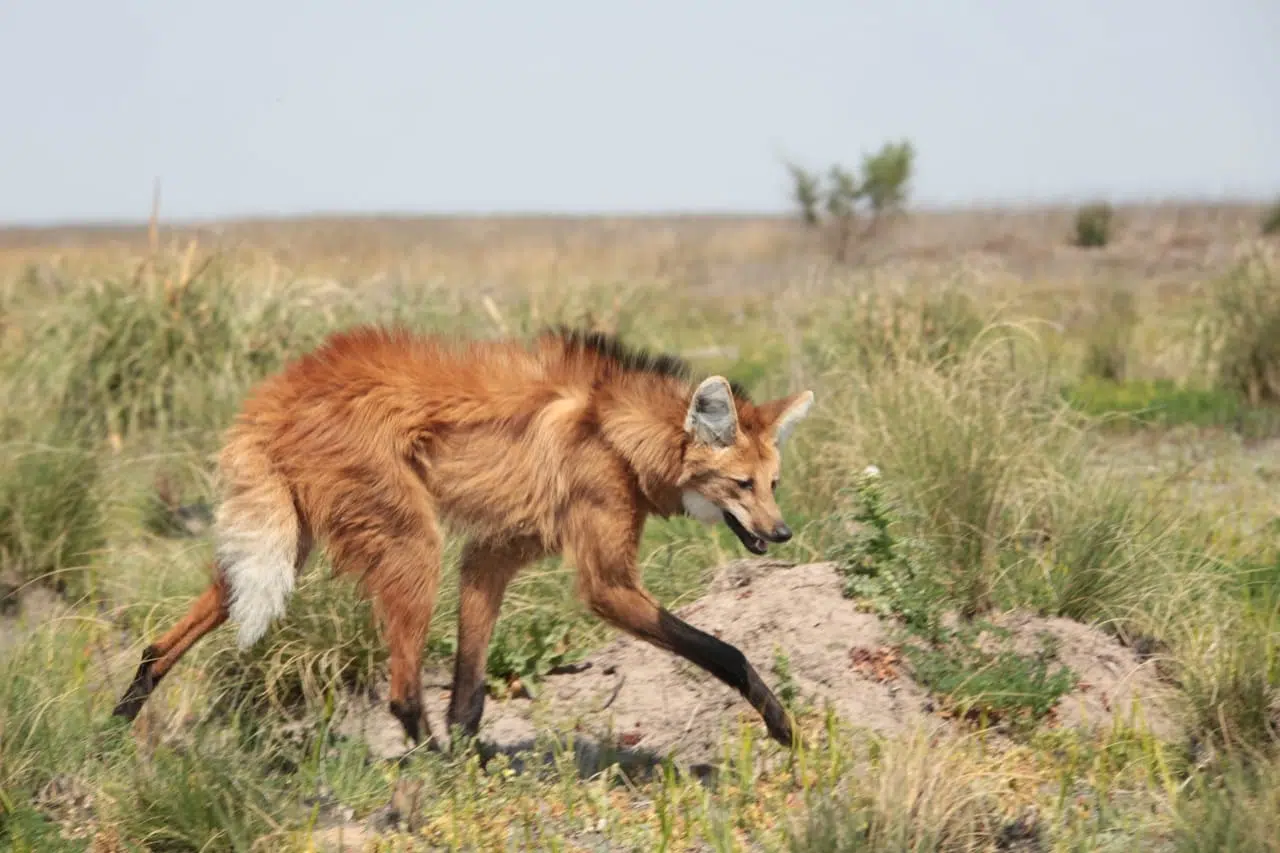
The province of Santa Fe has taken an important step in the conservation of biodiversity by releasing a young aguará guazú back into its natural habitat, after a process of assistance and recovery.
The individual, a young male, was released in the “El Fisco” Natural Reserve, located in the San Cristóbal department, with a monitoring collar to track its movements and gather essential data for the protection of this species.
The Minister of Environment and Climate Change, Enrique Estévez, highlighted the importance of this action: “We are building a model of active conservation, with science, environmental commitment and respect for biodiversity.” He added that “the transformation of La Esmeralda is part of that paradigm shift that we are decisively promoting in Santa Fe.”
Protection, care, and release: the story of the aguará guazú
The story of this aguará guazú began on Thursday, July 10th, when a report was received about the presence of the animal inside a shed in the city of Coronda.
Faced with this situation, specialists from the Rescue, Research, and Interpretation Center for Fauna “La Esmeralda” -dependent on the Ministry of Environment and Climate Change-, together with members of the Ecological Police, went to the location to assess the case and ensure the animal’s protection.
The individual was transported to the Center’s facilities, where it was provided accommodation in an enclosure specially prepared for its recovery.
It was a young male, less than two years old, in good overall condition.
During its stay at “La Esmeralda,” routine veterinary checks were performed, including a clinical examination, blood and urine tests, and additional studies. Additionally, a behavioral assessment was conducted to determine the feasibility of its reintegration into the natural environment.

Once the observation period was completed and its adequate health and behavioral condition were verified, the decision was made to release it into the “El Fisco” Natural Reserve, which is part of the Provincial System of Protected Natural Areas.
The choice of this location was based on specific ecological and conservation criteria for the species. Before the release into its natural habitat, and as part of an interinstitutional collaboration between the Province of Santa Fe and the Temaikén Foundation, a telemetry monitoring collar was placed on the animal.
This device will allow recording its movements in the wildlife and generating key information for the study and conservation of this protected species.
It is important to remember that the aguará guazú is protected by Law No. 12,182, which declares it a Natural Monument of the province of Santa Fe, granting it the highest level of legal protection.
In the presence of wild animals at risk, victims of illegal trafficking, or in a situation of being kept as pets, the Ministry of Environment and Climate Change urges citizens to call 911 to make the necessary report and notify the authorities.
The transformation of La Esmeralda
The Rescue, Research, and Interpretation Center for Fauna “La Esmeralda” (CRIFIF) is undergoing a profound process of institutional transformation. The aim is to establish it as a public space dedicated to the care, recovery, and rehabilitation of wildlife, the generation of scientific knowledge, and environmental education.
Currently, various lines of work are being implemented to progress in this direction. This includes specialized veterinary care and the reintegration of specimens into their natural habitat, as well as collaboration with universities, other wildlife centers, and local governments to develop long-term conservation strategies.
This process represents a significant paradigm shift regarding the role historically played by the site, previously known as “Granja La Esmeralda.”
For decades, it operated as a zoological station housing both domestic and wild animals with a primarily recreational focus. Today, “La Esmeralda” is envisioned as a modern center that combines science, technology, and environmental commitment to position itself as a key player in the conservation of Santa Fe’s biodiversity.


