



After 110 years of total absence, the guanacos returned to the National Park El Impenetrable, in Chaco.
They did so thanks to an ambitious project that allowed these large herbivores to be released back in the Dry Chaco, where they are native species but were no longer found.
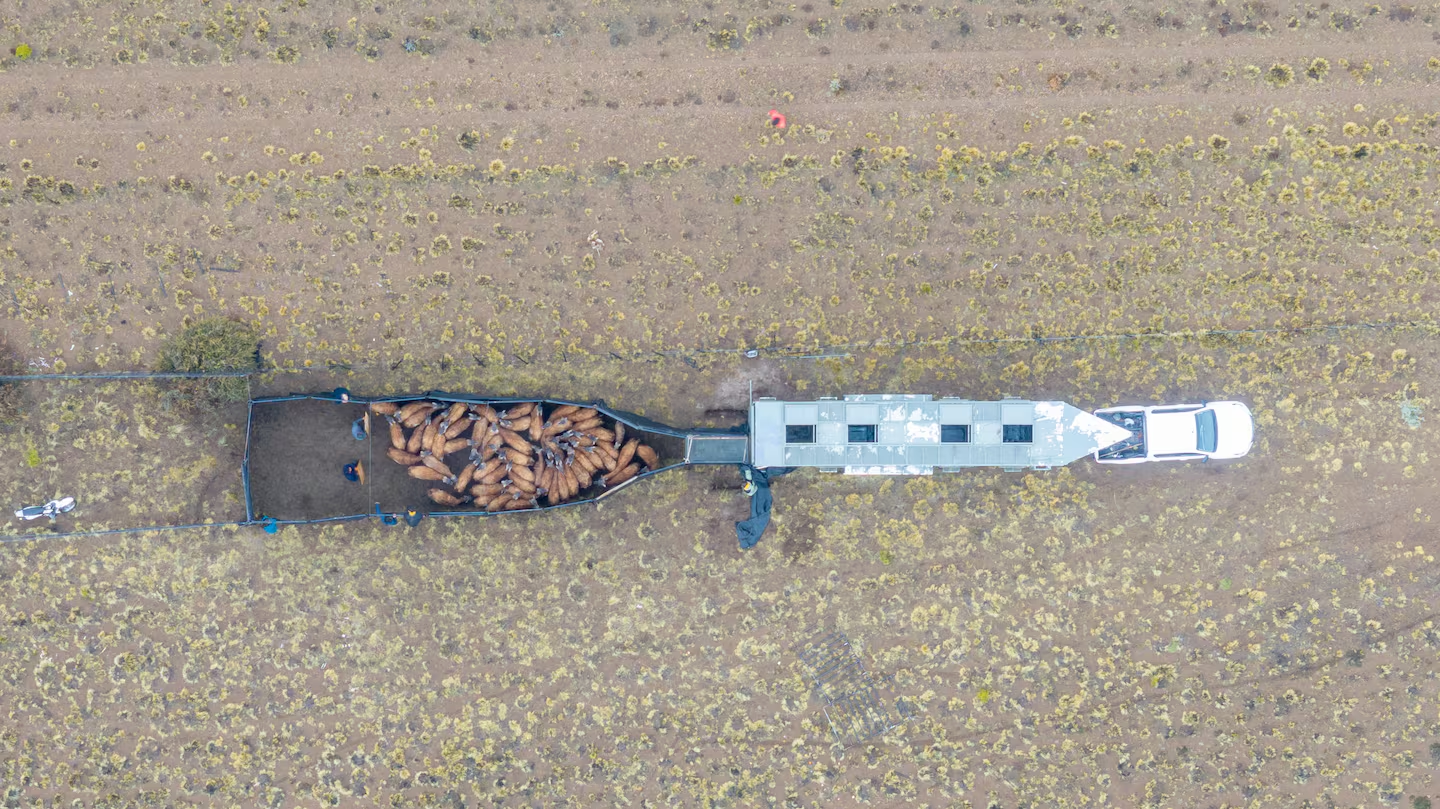
The operation, led by Rewilding Argentina along with the Administration of National Parks and provincial governments, mobilized specimens from the Patagonia Park in Santa Cruz.
It was a world record translocation for conservation purposes, as the guanacos traveled 3200 kilometers, from the Patagonian steppe to the Chaco forests.
The guanacos, a species disappeared due to human pressure
The guanaco, known as Nawananga by the Qom, Lu’hüt among the Wichís, and Guasukaka for the Guaraníes, inhabited for centuries the grasslands and savannas of the Dry Chaco.
However, intensive hunting, livestock expansion, habitat loss, and misuse of fire caused their complete disappearance from the region.
Montiel Romero, a representative of the Qom community, explained: “Nawananga is what we call the guanaco in Kom Lattaka (Toba language). In ancient times and times known by the older Tobas, there were nawananga all over the Chaco. Since the whites came, they have disappeared in the Chaco.”

Currently, in the entire Chaco region—a territory of almost one million square kilometers—only a hundred specimens survive on the border between Paraguay and Bolivia.
On the Argentine side, no populations had been recorded for more than a century.
How was the logistics for the guanacos to return to Chaco
The reintroduction required a complex logistics that included specialized techniques of herding and capture, the design of adapted trailers, and the construction of pre-release corrals.
During the transfer, animal welfare and safety were prioritized throughout the journey.
In the Patagonia Park, Rewilding Argentina maintains programs of genetic and population monitoring with the support of Fundación Freyja.
These evaluations allowed identifying the suitable individuals to repopulate new regions.
Once in El Impenetrable, the animals remained in corrals where they acclimated to the new environment.
There, the first chulengos were born in Chaco territory and began to incorporate native plants into their diet.
The key ecological functions of guanacos for the ecosystem
The absence of large herbivores like the guanaco, the pampas deer, or the marsh deer leaves deep marks on the Chaco ecosystem.
These animals perform functions that no small herbivore can replace:
- They disperse seeds through their movements
- They regulate vegetation through grazing
- They prevent fires by reducing accumulated flammable material
- They distribute nutrients and shape the landscape
- They sustain complete trophic networks as prey and resource for scavengers
According to documentation from Rewilding, “their ecological functions cannot be replaced by smaller herbivores, so the absence of these species degraded the ecosystems of El Impenetrable“.
The return of the guanaco to Chaco adds to previous recovery efforts for the yabotí tortoise, the jaguar, and the giant otter.
Additionally, it creates a new tourism opportunity for wildlife watching, a modality that already generates income for Chaco families.
The strategic plan includes the release of new specimens in the coming months to strengthen the population’s viability and ensure the ecological restoration of El Impenetrable National Park.



