



Four exclusive animals of the Amazon are facing a critical risk of extinction. The pressure on their habitats and hunting combine in a scenario that threatens not only their future but also the ecological stability of the world’s largest tropical rainforest.
This biome extends across nine South American countries and concentrates about 20% of the world’s flora and fauna. Its diversity makes it a unique refuge, but also an extremely vulnerable ecosystem.
The Amazon basin, which stores one-fifth of the world’s freshwater, is a natural pillar whose degradation impacts far beyond the region.
Amazonian Manatee: the peaceful giant in retreat
The Amazonian manatee is the smallest of its family and lives exclusively in freshwater. It can exceed two meters and reach 500 kilos, moving between rivers in Ecuador, Peru, Colombia, and Brazil.
Its population, estimated between 8,000 and 30,000 individuals, places it as a vulnerable species. Its herbivorous diet and long life cycle make it especially susceptible to environmental changes.
The predatory hunting and accidental capture in nets reduce its presence and hinder the recovery of its populations.

Giant Otter: the unprotected predator
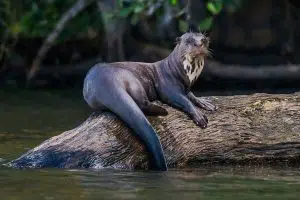
The giant otter is one of the most threatened mammals on the continent. It inhabits riverbanks with dense vegetation and less intervened areas, where it forms very cohesive family groups.
It feeds on fish and crustaceans, but its diet is affected by mining and logging pollution. The reduction of prey compromises its survival.
It was also historically a victim of hunting for its skin, an impact that still resonates in its scattered populations.
White-faced Spider Monkey: an acrobat in danger
The white-faced spider monkey lives high in the forest canopy, where it uses its prehensile tail as a fifth limb. This frugivorous primate travels great distances in search of ripe fruits.
Its vulnerability increases with the loss of forests, as it depends on tall trees for shelter and food. Hunting also seriously affects the species.
Its disappearance would alter seed dispersal, a key function in forest regeneration.

Pink Dolphin: an Amazonian symbol fading away
The pink dolphin is a cultural and ecological icon of the region. Its echolocation ability allows it to move between murky waters and complex river systems.
It can exceed two meters and exhibits colorations that intensify with age, especially in males. Its distribution includes the Amazon, Orinoco rivers, and their main tributaries.
The poaching and river pollution are its main threats, aggravated by the lack of updated population counts.

Why these species are vital for the Amazon
The manatee regulates aquatic vegetation; the otter controls fish populations and balances food chains; the spider monkey disperses seeds essential for forest health; and the pink dolphin is a biological indicator of water quality.
Their disappearance would create imbalances that would affect biodiversity and the lives of communities that depend on the river and forest for survival.
The loss of endemic species causes irreversible damage, as there are no populations outside the Amazon capable of ensuring their recovery.
How to protect these Amazonian species
Conservation requires combined actions that address both human pressure and environmental degradation. The restoration of riverbanks and forests is key to recovering critical areas where these animals feed and reproduce.
Strengthening surveillance in rivers and isolated areas helps reduce poaching and accidental capture. It is also essential to promote productive practices that reduce mining and agricultural pollution.
Environmental education and the participation of local communities are pillars to ensure that the protection of these species becomes part of regional development.
An urgent call to save lives and preserve the biome
The Amazon faces one of the greatest biodiversity crises in its history. These four animals, unique in the world, represent both the richness of the biome and the fragility it suffers from human intervention.
Protecting them means defending the ecological balance of millions of kilometers of jungle and ensuring a possible future for those who depend on it.

