



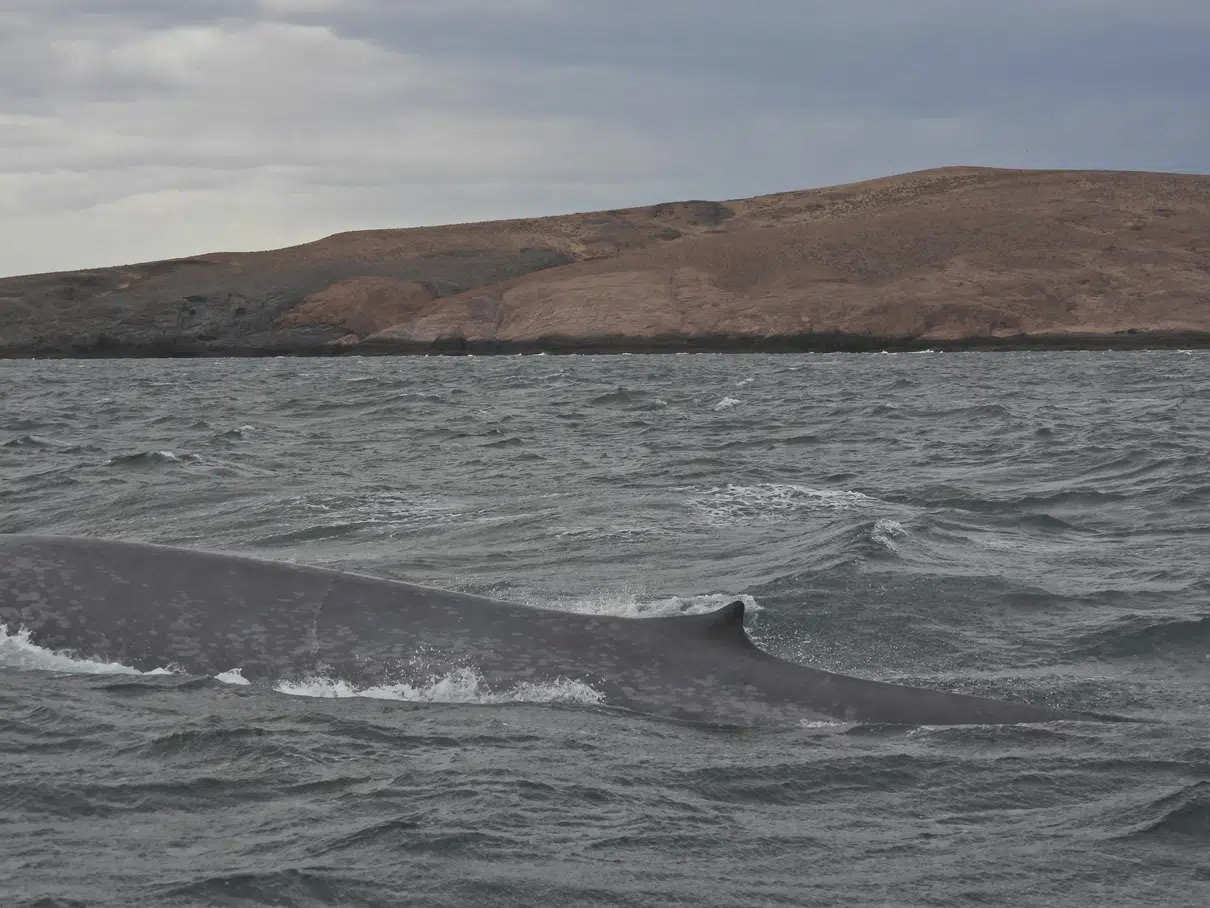
For the first time, the presence of a blue whale was documented in the Patagonia Azul Provincial Park, Chubut.
The sighting was made by the conservation team of Rewilding Argentina during a routine monitoring outing. The discovery marks a scientific and conservation milestone, as this species had never before been recorded within the park’s boundaries.
Biologist Tomás Tamagno recounted that the day began with sightings of humpback and sei whales, but among them emerged a much larger silhouette: “We encountered this whale coming out of the water, but this one was different, it was gigantic, much larger than any other we had seen.”
The largest animal on the planet
The blue whale (Balaenoptera musculus), considered the largest animal ever to inhabit the Earth, can reach 30 meters in length and weigh between 75 and 140 tons. To put the discovery into perspective, Tamagno compared: a humpback whale measures up to 16 meters and weighs between 25 and 35 tons. The scale difference is enormous.
The sighted specimen likely belongs to the Antarctic Blue Whale subspecies, which traverses the waters of the Southwestern Atlantic.
Importance for conservation
The blue whale is classified as “Endangered” because 20th-century commercial whaling reduced its populations to just 2% of their original size in the southern hemisphere. Its recovery is slow and depends on the existence of protected marine areas that offer safe biological corridors against threats such as ship collisions.
The record in Cabo Dos Bahías reinforces the value of the Patagonia Azul Park as a key space for marine biodiversity. “Seeing it so close to the coast is really rare and greatly highlights the importance of this place for conservation,” Tamagno noted.
Mysteries of an ocean traveler
Unlike other baleen whales, the blue whale feeds year-round, consuming between 3 and 5.5 tons of krill per day. Its biology in the Argentine Sea still holds mysteries, so this sighting opens new lines of research.
The team reflected that the presence of the specimen could indicate that it finds food in these waters, although these are preliminary hypotheses.
An unforgettable day
The sighting was celebrated as a gift from nature and a professional incentive for the researchers. “It was an incredible day, surrounded by jumping humpbacks and the appearance of this specimen. We are very happy to have been able to confirm the presence of the blue whale within the Park,” concluded Tamagno.

