



Less than a decade ago, what seemed like an environmental utopia is now a **tangible reality**: [the province of **Corrientes**](https://noticiasambientales.com/animales/rehabilitaron-y-liberaron-a-cuatro-monos-caraya-en-corrientes-como-sera-la-reintroduccion-a-su-habitat-natural/) emerges as a **continental benchmark in nature production**, thanks to the sustained growth of the **jaguar population** in the **Iberá Wetlands**.
In 2024, there were an estimated **25 individuals**, and currently, there are between **35 and 40 individuals**, solidifying the **rewilding project** as a **global success**.
## Reintroduction and coexistence: the return of big cats
Jaguars adapt, reproduce, and expand their territory without productive conflicts.
Since the release of the first individuals, the jaguars have shown **exemplary adaptation**, coexisting with other reintroduced species such as **collared peccaries** and **howler monkeys**.
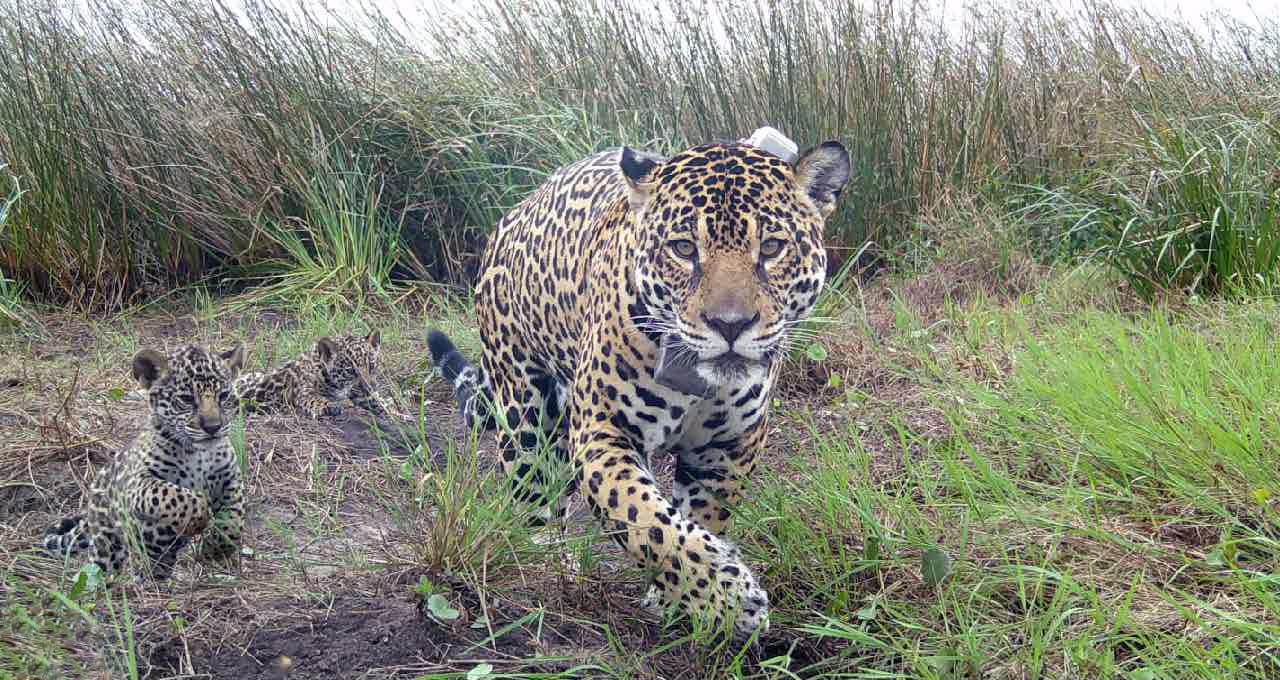
A video from [**Rewilding Argentina**](https://www.rewildingargentina.org/), titled *“Iberá Renewed in 30 Seconds”*, shows the female jaguar **Karaí** with her cubs **Poo Guazú and Mimbí**, hunting and playing in their natural habitat.
According to **Marisi López**, coordinator of the Iberá Committee, many cubs are born in the wild and do not wear monitoring collars, but they can be **identified by the unique pattern of their spots**, allowing their **evolution to be monitored without interference**.
## Territorial dispersion and ecological role of the top predator
The felines cross lagoons and fields without attacking livestock, hunting pest species.
The project’s success has allowed the jaguars to **expand their territory beyond San Alonso Island**, with sightings in areas such as **Itá Ibaté** and cattle ranches.
López highlights that **no attacks on livestock have been recorded**, and the felines fulfill their ecological role by **controlling populations of wild pigs**, a pest species in the region.
## Iberá Plan: conservation as a regional development driver
**Tourism, infrastructure, and culture integrated in over 13 municipalities**.
Governor **Gustavo Valdés** reaffirmed that conservation is directly linked to **territorial development**. The **Iberá Plan** aims to consolidate Corrientes as a **natural and touristic gem**, integrating:
– **Infrastructure**: roads, navigable channels, and land allocation for hotel ventures
– **Training**: park ranger education and community environmental education
– **Diversification**: promotion of trades, local gastronomy, and carbon footprint certification
“Iberá is conservation, tourism, gastronomy, public works, and culture,” stated Valdés, emphasizing that the Wetlands must be part of **the country’s best touristic offer**.
## Conservation with impact: nature, identity, and well-being
The return of the jaguar demonstrates that [**protecting biodiversity**](https://noticiasambientales.com/animales/cordoba-protege-su-biodiversidad-ocho-especies-fueron-declaradas-monumento-natural-provincial-por-su-rol-ecologico/) generates local wealth.
The recovery of the **jaguar**, an emblematic species of the region, not only represents an **environmental triumph** but also a **development engine** that articulates **biodiversity, economy, and culture**.
The Iberá Wetlands thus become a **top-tier nature destination**, the foundation of a comprehensive model that positions Corrientes on the **global map of active conservation**.



