



Pumas and penguins are at the center of an unprecedented ecological conflict in Monte León National Park, in the Argentine Patagonia.
A study by the University of Oxford estimated that more than 7,000 adult penguins died from puma attacks in just four years.
The research, published in the Journal for Nature Conservation, analyzed data collected between 2007 and 2010 by the Puerto Deseado Research Center of the National University of Austral Patagonia.
The records included the count of penguin carcasses with signs of puma predation within the national park.
The phenomenon has a clear origin: when livestock farming was abandoned in southern Argentina in the 1990s, pumas began to recolonize their historical area.
At the same time, Magellanic penguins expanded from nearby islands to the continent, where there were previously no terrestrial predators.
The encounter between both species created what scientists call a conservation dilemma.
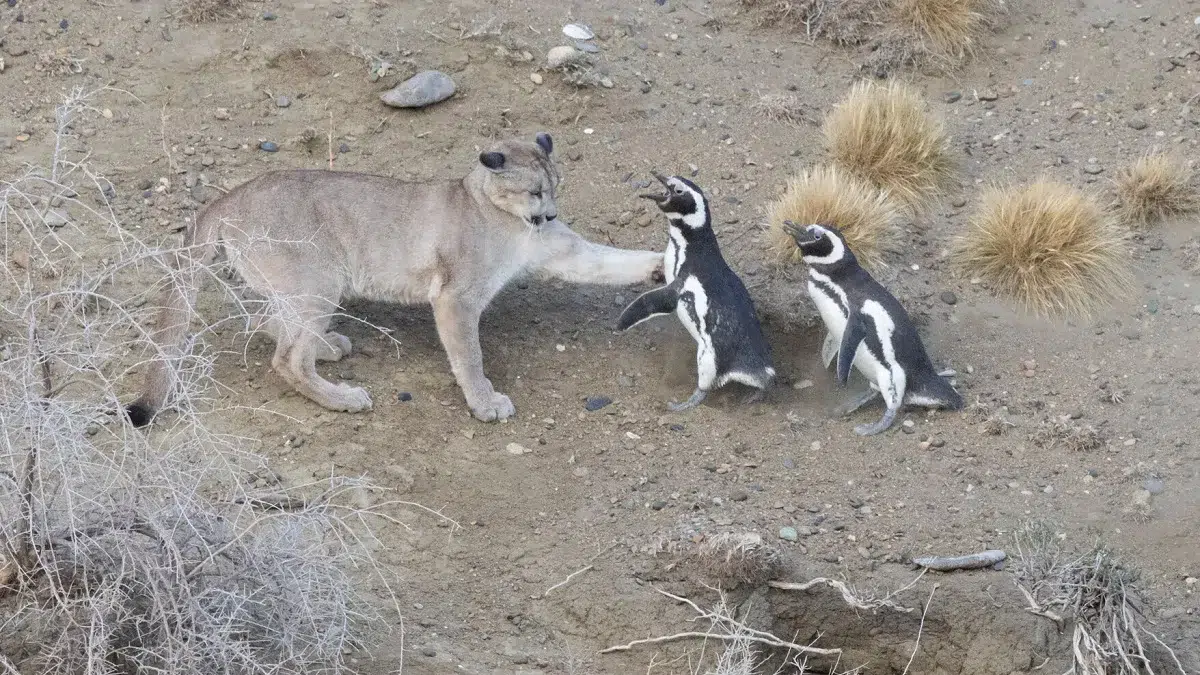
Pumas vs. penguins: more deaths than food
One of the most striking findings of the study was that most of the penguins killed were not completely consumed by the pumas.
This represents, according to the researchers, a case of surplus killing or excessive killing.
“The number of carcasses showing signs of predation in the colony is overwhelming,” stated Melisa Lera, the lead author of the study.
“The fact that they were left uneaten means that the pumas were killing more penguins than they needed for food,” Lera added. The phenomenon is similar to the behavior of domestic cats with birds.
The 7,000 deaths recorded represented about 7.6% of the adult penguin population in the park during that period.

What factors define the future of the penguins?
The models developed by the researchers indicated that pumas alone would not lead the penguin colony to extinction.
However, they identified other determining factors for the population’s viability:
- Reproductive success of adult pairs
- Juvenile survival during their early years
- Availability of food in the sea
- Temperature and climatic conditions of the environment
- Levels of nutrients in the marine ecosystem
“This study reflects an emerging challenge for conservation, where recovering carnivores encounter new prey,” noted co-author Dr. Jorgelina Marino.
“Understanding how these dietary changes affect both predators and prey is essential to guide conservation strategies,” added Marino.
In this scenario, the pumas and penguins of Monte León are currently under monitoring by park authorities, who are tracking both populations.
Meanwhile, scientists will continue to analyze how climate change could exacerbate the impact of predation on the future of Magellanic penguins on the continent.



