



The Aconcagua Provincial Park implemented a regulation that revolutionizes the protection of pack mules.
Now, fines in case of mistreatment of these animals key for the exploration of the Park will reach up to $25 million.
Additionally, new animal welfare standards were established as guidelines to follow: the details.
The cases of mistreatment that motivated the update
The update arises after an embarrassing report from the Public Prosecutor’s Office of Mendoza conducted almost a year ago.
This led to complaints from various NGOs for animal mistreatment, specifically of the mules, in Aconcagua Park.
Currently, eight authorized companies operate in the area with about 800 mules in total, which work tirelessly during the high season.
After a provincial inspection, a judicial case was opened.
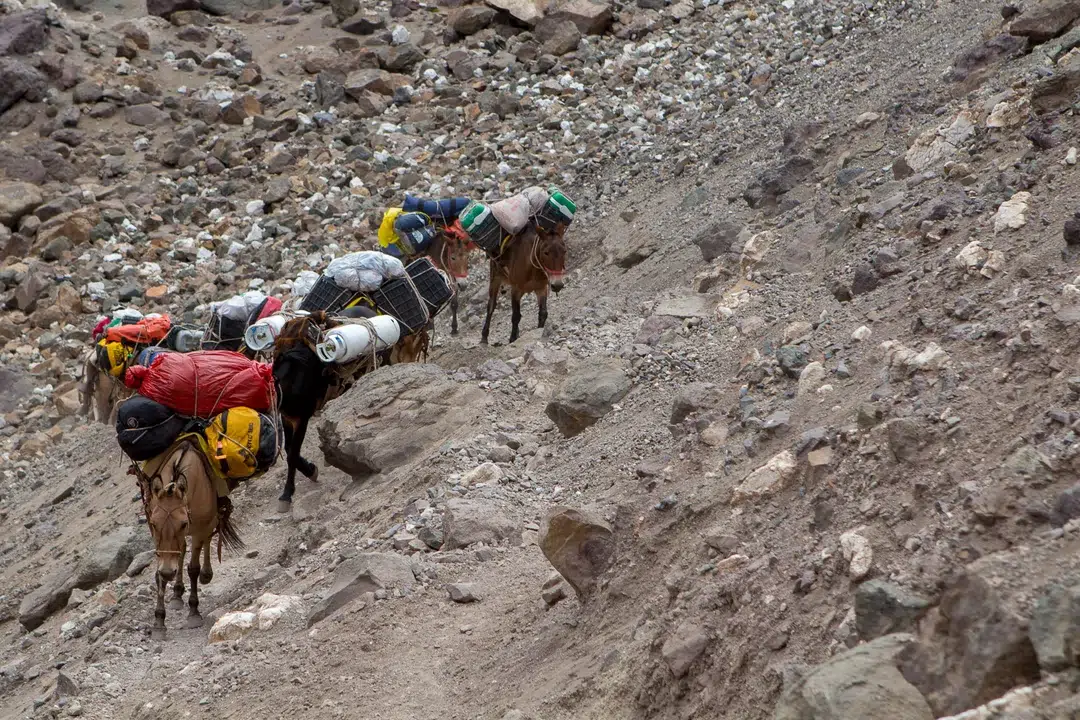
In particular, the case that motivated the prosecutorial investigation was the sacrifice of Lunático, a mule that agonized for three days abandoned in Aconcagua.
The animal was finally euthanized last December with permission from the Veterinary College of Mendoza.
During the inspections conducted in January in places like Puente de Inca and Plaza de Mulas, about 300 mules were reviewed.
Seventy of them needed urgent veterinary attention for burns, injuries, and malnutrition.
Prosecutor Gabriel Blanco, from the Environmental Crimes Unit, charged muleteers for animal mistreatment under the Law 14.346.
Cases were even documented where mules were forced to carry batteries that spilled acid on their backs.
The investigation confirmed the non-compliance with the current Animal Welfare Program.
The mules had scabs, open wounds, and evident signs of overexploitation on the routes of Aconcagua Park.
The new standards for mule care in Aconcagua
Last week, the Directorate of Protected Areas (DAP) of Mendoza approved the update of the Animal Welfare Program.
This incorporates stricter technical requirements and strengthens the sanction regime for companies and muleteers.
The measure establishes fines reaching 50,000 UF (equivalent to $25 million) for very serious violations.
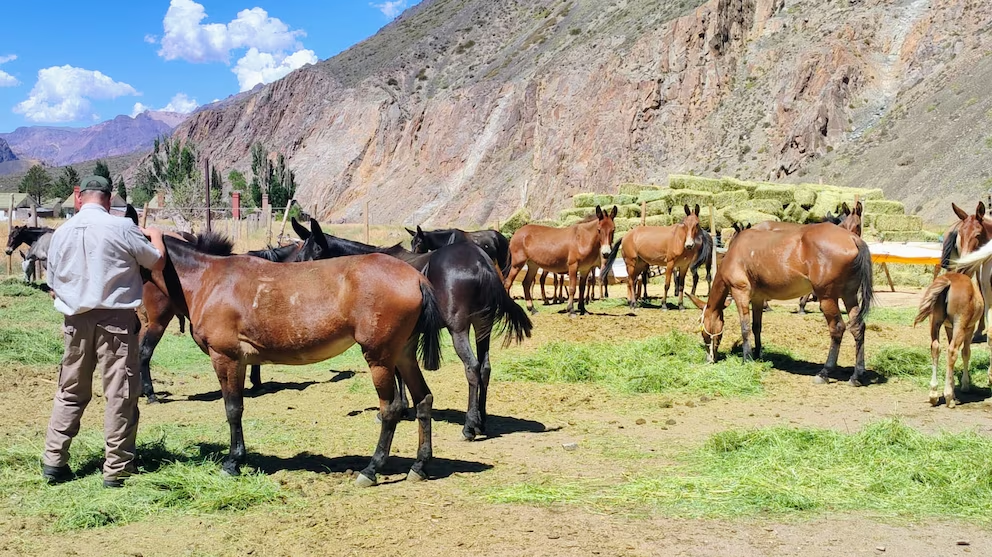
Additionally, the sanctions also include the permanent suspension of muleteers.
The new regulation also establishes a single admission per season, conducted exclusively by veterinarians from the Program.
Therefore, animals must now have chip identification and digitized Health Records.
This information will enable an electronic database with all the health information of the mules that companies operating in Aconcagua must share.
Mandatory records of entries, exits, veterinary checks, and injuries are also incorporated.
Each company must designate a “Compliance Officer,” a veterinarian responsible for ensuring the comprehensive compliance of the Program.
This professional will assume joint responsibility in case of violations.
Finally, the corrals must meet certain requirements regarding space, available water, and adequate shelter.
The mules used in Aconcagua Park will receive between 20 and 70 liters of water daily, in addition to hay and grains, according to established minimum standards.
Strict schedules and mandatory rest for the mules of Aconcagua
In the Horcones Gorge, the inspection will begin at 6 a.m. The entry of mules to Aconcagua will be allowed until 11 a.m. for expeditions heading to Plaza de Mulas.
The minimum rest between consecutive entries of the same animal will be 24 hours in Horcones. In the Vacas Gorge, the mandatory rest reaches 48 hours.
The Punta de Vacas—Plaza Argentina—Punta de Vacas route must be completed in a minimum of three days. Overnight stays of animals in unauthorized areas and above 3300 meters are prohibited.

Violations and sanction regime
The regime classifies offenses as minor, serious, and very serious. Violations range from lack of cooperation with inspectors to animal mistreatment and the use of prohibited items.
Animal mistreatment, negligent handling of loads, and the death of mules by action or omission constitute very serious offenses.
Spurs and harsh punishments are strictly prohibited.
Additionally, companies in Aconcagua Park must submit sworn statements about feeding, and these will be subject to periodic inspections by the enforcement authority.
At the end of each season, a technical report with statistics of entries, rejections, and performance indicators will be prepared.
This will be presented to the Advisory Commission of the Aconcagua Provincial Park (CAPPA) for definition.
The update was developed based on the oversight experiences of the previous season.
It also considered the technical analysis of veterinarians from the Biodiversity and Ecopark Directorate.



