



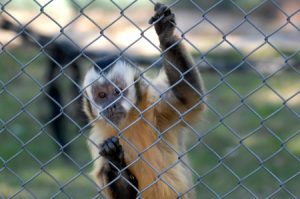
A capuchin monkey approximately three months old was rescued in the Villa 31 neighborhood in Retiro, following a raid that detected its transport in conditions of captivity. The procedure was initiated based on a report of alleged environmental violation.
The intervention was carried out by the Argentine Federal Police, through the Department of Environmental Crimes of the Federal Investigations Department. The woman was intercepted near the train terminal while transporting the animal in a box.
The operation involved the participation of the Environmental Prosecutor’s Unit and led to the intervention of the National Criminal Court and Correctional Court No. 8, which ordered the arrest of the suspect for violating the wildlife protection regulations.
Protected species and recovery process
The specimen belongs to the species Sapajus apella, native to northern Argentina and neighboring countries. It is a protected primate under the Law 22.421 on Wildlife Conservation.
After the rescue, the monkey was taken to the Interactive Ecopark of the City of Buenos Aires. There it will undergo a veterinary evaluation, treatment, and a rehabilitation process aimed at its eventual reintegration into its natural habitat.
These types of interventions aim not only to save the affected individual but also to dismantle trafficking networks that impact vulnerable wild populations. The extraction of young also implies the death or displacement of adults in their natural environment.
The dangers of captivity for wildlife
Keeping wild animals in captivity poses a risk both to their well-being and to biodiversity. Firstly, young separated from their mothers suffer extreme stress, behavioral alterations, and immunological problems.
Additionally, primates require complex social structures to develop properly. Isolation in domestic environments prevents the learning of essential behaviors for survival in the wild.
On the other hand, captivity facilitates the transmission of diseases between humans and wildlife. This health exchange can generate outbreaks that affect entire ecosystems and, in turn, pose a risk to public health.

Illegal trafficking and environmental challenge
The illegal wildlife trade is among the main threats to biodiversity in Latin America. The demand for exotic animals as pets fuels a chain that begins with capture in native forests.
Consequently, each detected case highlights the need to strengthen controls and awareness campaigns. Effective protection requires coordination between security forces, justice, and environmental agencies.
Thus, the rescue in Villa 31 is not an isolated incident. It constitutes a warning sign about the urgency of stopping species trafficking and promoting a responsible relationship with wildlife.



