



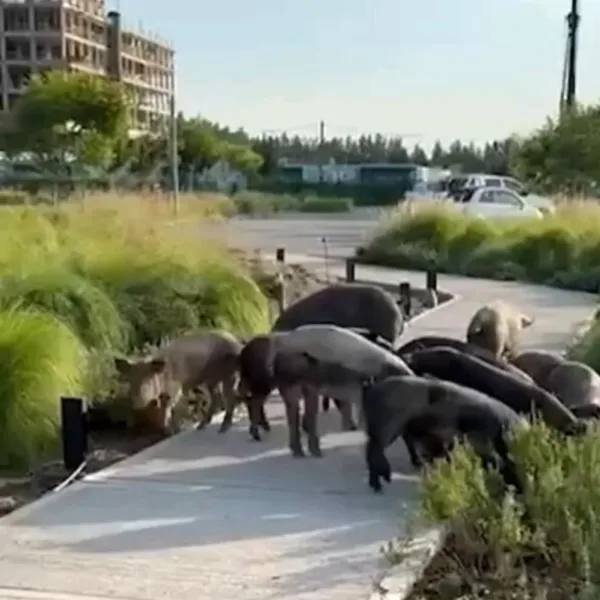
The situation in Nordelta has once again brought an underlying environmental conflict to the forefront. In addition to the well-known episodes of coexistence with capybaras, there have been neighborhood complaints about the alleged presence of wild boars in residential areas.
Following these reports, videos began circulating showing several animals moving in groups, searching through garbage bags, and causing damage to gardens. However, neighborhood control areas downplayed the veracity of the images.
Nonetheless, beyond the official confirmation, the episode rekindled concern about the interaction between wildlife and private urbanizations.
Neighborhood Concern and Lack of Records
The possibility that wild boars have entered the complex has alarmed residents. In particular, the risk posed by contact with large animals and their unpredictable behavior was mentioned.
From the administrative environment, it was noted that there were no formal complaints or subsequent records. Even so, the concern persisted in the face of lack of certainty.
This tension shows how, even without conclusive evidence, the perception of risk sets in when ecosystems are altered.
Environmental Changes as a Structural Cause
Specialists and residents agree on linking these episodes to recent environmental transformations. Real estate developments, soil movement, and the removal of green areas reduce the natural habitat.
As a result, various species are forced to move towards urbanized areas in search of shelter and food. Thus, the boundaries between the natural and the residential become increasingly blurred. This process is not isolated and is repeated in multiple urban developments in the metropolitan area.
The Ongoing Conflict Over Capybaras
In parallel, the controversy continues over the management of the capybara (Hydrochoerus hydrochaeris) population in Nordelta. The initiative to relocate specimens has caused a deep division among residents.
Those who support the measure argue that the overpopulation causes accidents, material damage, and potential health risks. Therefore, they supported a plan that provided for the limited relocation of animals.
In contrast, other residents and protective organizations questioned the operation and defended the capybaras as a native species displaced by urban growth.
Management, Criticism, and Alternatives
The operation was carried out with cages, sedation, and official supervision, relocating six specimens to a private reserve. However, criticism soon emerged.
Environmental groups denounced the violation of precautionary measures and demanded greater transparency. They also pointed out the impact of stress and the social fragmentation of the animals.
In response, they proposed alternatives such as ecological corridors, road signage, and speed reducers to minimize conflicts without resorting to forced relocations.

Wild Boars and Their Possible Causes
The potential presence of wild boars in Nordelta could be due to similar dynamics. These animals tend to expand when they lose natural territory or find easy food in urban areas.
The accumulation of waste, proximity to degraded wetlands, and real estate pressure create favorable conditions for their movement. Moreover, the lack of biological corridors intensifies these movements. Thus, the appearance of wild boars would not be an isolated event but a sign of environmental imbalance.
A Call to Rethink the Urban Model
Ultimately, the cases of capybaras and wild boars reflect the same structural problem. Urban expansion over wetlands and natural areas generates conflicts that are then attempted to be resolved reactively.
Rethinking the relationship between city and nature is key to avoiding new episodes. Environmental planning, ecosystem conservation, and responsible coexistence emerge as central axes.
Only in this way will it be possible to reduce tensions, protect biodiversity, and ensure a more balanced relationship between people and wildlife.



