



The latest global count by the International Rhino Foundation brought encouraging news: the population of black rhinos, a critically endangered species, grew from 6,195 to 6,788 individuals. This increase, though modest, marks an important difference for their conservation. However, the situation is not the same for all species.
White rhinos, also found in Africa, decreased from 15,942 to 15,752 individuals, showing a slight but concerning decline. In Asia, the single-horned rhinos living in northern India and Nepal recorded a slight increase, reaching 4,075 individuals.
On the other hand, the situation is critical for the Javan rhinoceros, whose population dropped drastically from 76 to only 50 individuals due to poaching. Today, this species survives only in a national park on the Indonesian island of Java. The status of the Sumatran rhinoceros remains stable, with between 34 and 47 individuals.
Globally, it is estimated that there are around 26,700 rhinos in the wild, distributed in national parks and reserves, not counting those living in zoos.
 Kenya’s measure to preserve black rhinos. (Photo: Wikipedia).[/caption>
Despite the slight increase, threats and illegal trafficking continue
The largest concentration of rhinos remains in southern Africa, but even there, the numbers in individual populations fall below the threshold needed to maintain genetic viability. Conservationists are concerned that population fragmentation could weaken the species.
Illegal trafficking continues to fuel the black market, especially in Asia, where horns are valued for cultural beliefs and unproven medicinal uses. South Africa, which holds a large portion of the global population, loses between 400 and 500 individuals per year due to poaching. New routes, like the connection between South Africa and Mongolia, and the growing role of Qatar as a trading hub, exacerbate the problem.
To combat this threat, scientists are exploring innovative measures, such as injecting harmless radioactive material into the horns, which would allow them to be detected at border controls and discourage their smuggling.
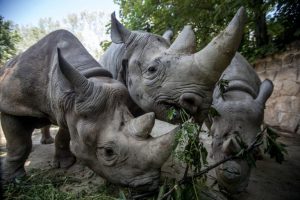 A slight increase was recorded in the population of black rhinos.
Conservation status of the black rhinoceros
The black rhinoceros (Diceros bicornis) is classified as a critically endangered species by the International Union for Conservation of Nature. Its population, although partially recovering, continues to face constant pressures from habitat loss and poaching.
Historically, its distribution covered much of sub-Saharan Africa, but today its presence is limited to countries like Namibia, South Africa, Kenya, and Tanzania, with isolated populations in other parts of the continent. It prefers savannas, shrublands, and semi-arid areas, where it feeds mainly on leaves and shoots.
The recovery of this species depends on strict protection programs, ecological corridors connecting populations, and coordinated efforts between governments, local communities, and international organizations. The current slight growth demonstrates that conservation measures can yield results if sustained over time and strengthened against emerging threats.



