



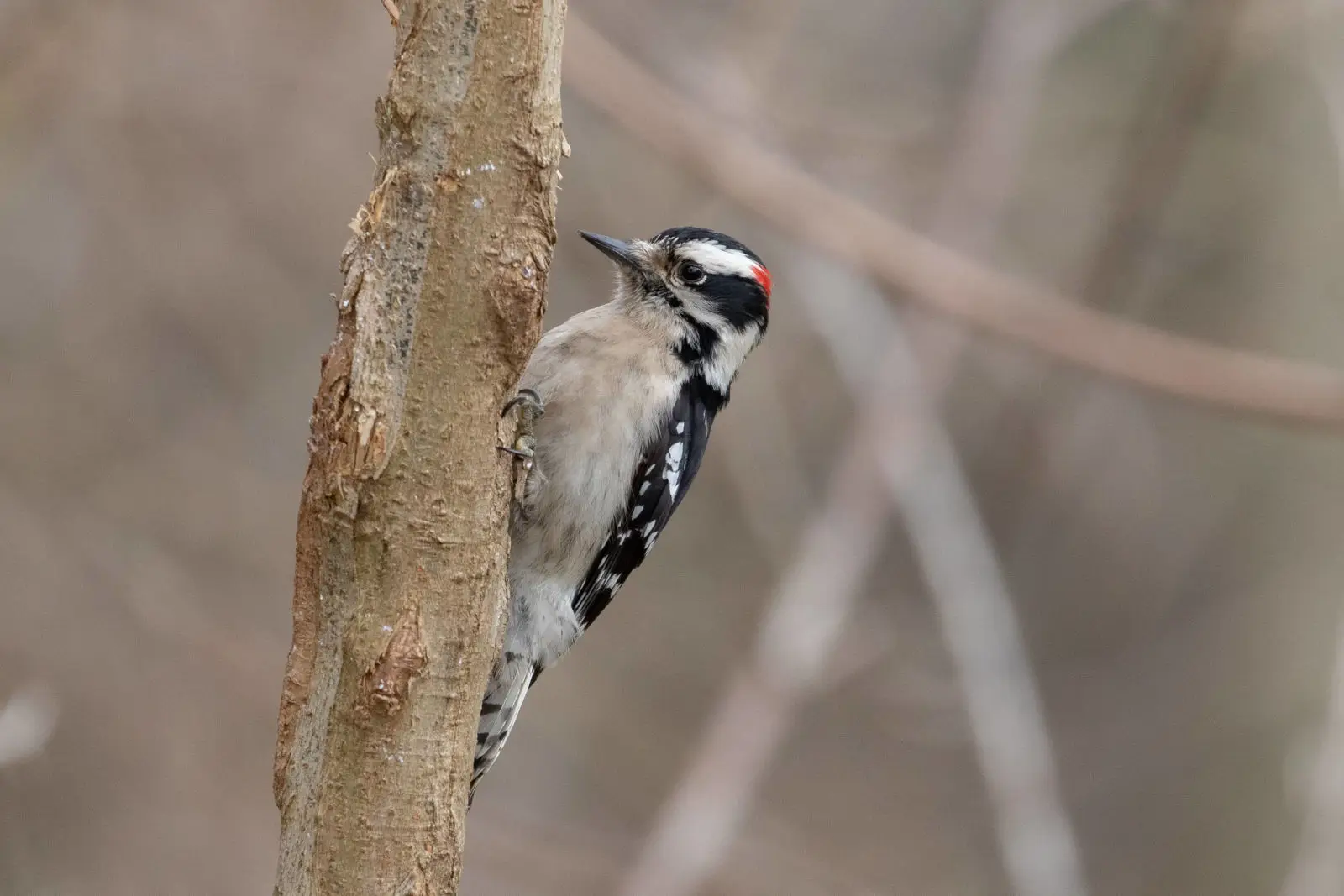
The Downy Woodpecker (Dryobates pubescens), the smallest in North America, defies expectations by striking the hard bark of trees with a force that multiplies between 20 and 30 times its own body weight. With more than 13 million adult specimens distributed across the continent, this species has become a subject of special attention for the scientific community.
A study published on November 6, 2025 and cited by Smithsonian Magazine confirmed that the secret of this “living hammer” lies in a muscular and bodily coordination never before observed.
An unprecedented biomechanical analysis
At Brown University, under the direction of Nicholas Antonson and Matthew Fuxjager, a team of researchers studied eight individuals through high-speed video recordings and electrical measurements in the muscles of the head, neck, abdomen, hips, tail, and legs.
Additionally, they monitored the pressure and airflow in the airways of six birds, which were later released into their natural environment.
The findings show that the Downy Woodpecker not only uses its beak and neck: it activates a muscular network that spans from the head to the tail.
- The hip flexors and the frontal neck muscles drive the body with each strike.
- The posterior neck muscles and the base of the skull stabilize the head.
- The abdomen and tail contribute to the balance and precision of the movement.
Antonson explained:
“They recruit muscles in the head, neck, hips, abdomen, and tail, essentially using the entire body to forge a coordinated hammer, with the neck stiffened at the moment of impact similarly to how the human wrist does when using a hammer.”
The role of breathing
The study highlights a key element: the respiratory component. Researchers observed that, with each strike, the bird exhales powerfully, similar to the “grunt” of professional tennis players when hitting the ball.
This technique stabilizes the body core and amplifies the impact force, both in birds and human athletes. Additionally, the Downy Woodpecker performs “mini-breaths” between pecks, synchronizing each inhalation with a strike, at a rate of up to 13 times per second.
This pattern is not exclusive to woodpeckers. Previous studies indicate that songbirds also perform mini-breaths during singing.
Neuroscientist Daniel Tobiansky, from Providence College, noted that this shared behavior suggests that the pecking of woodpeckers might be more related to singing than previously thought:
“This shared behavior suggests that [pecking] might resemble singing more than we had imagined.”
Seasonal adaptations and survival
The research also provides information on the habits and distribution of the species. The Downy Woodpecker is endemic to North America and, in winter, males and females modify their foraging patterns, increasing their search for food in trees.
This seasonal adaptation highlights the importance of precise muscular and respiratory coordination to survive in adverse conditions.
A challenge to animal biomechanics
For Matthew Fuxjager, the most astonishing thing about the Downy Woodpecker is not just the speed of its movements, but the skill with which it integrates all its body systems to perform a task that, due to its scale and complexity, challenges the limits of animal biomechanics.
The study not only reveals the extraordinary capability of this small bird but also opens new perspectives on the relationship between breathing, singing, and movement in birds, providing insights into how nature perfects mechanisms of strength and precision that even inspire human science.



