



United States has been reinforcing for years an unprecedented strategy to protect its rivers. Therefore, federal agencies install electric barriers at key points to stop the Asian carp before it reaches the Great Lakes.
This measure does not respond to a recent urgency. On the contrary, it is part of a sustained plan of ecological protection. Thus, it seeks to safeguard ecosystems and economies linked to clean water.
The Great Lakes concentrate one of the largest freshwater reserves on the planet. Consequently, any alteration would have ecological and social effects. Hence the magnitude of the response implemented.
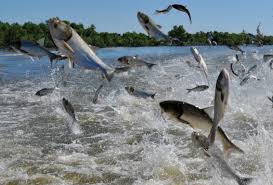
Electric barriers and technology to contain the invasion
The main line of defense is located in the Chicago Sanitary and Ship Canal. There, since the early 2000s, submerged electric barriers have been operating. These generate fields that discomfort the fish and force them to retreat.
Unlike other methods, the current does not aim to eliminate the animals. However, it creates an artificial border difficult to cross. In this way, access to Lake Michigan is protected.
Additionally, the system is complemented with sound barriers and bubble curtains. These solutions reinforce containment during floods or extreme events. Thus, the defense adapts to a changing river environment.
A constant advance through the interior rivers
The Asian carp continues to expand through the Mississippi system. Therefore, control must be permanent and coordinated. Any failure could facilitate its entry into new basins.
The Brandon Road Interbasin project concentrates additional efforts. This point is key because it connects strategic waterways. There, it seeks to close one of the last possible accesses.
Although the barriers have been effective, the risk persists. In fact, genetic traces have been detected upstream. This shows that vigilance cannot be relaxed.
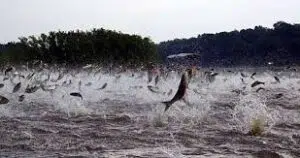
What is the Asian carp and why does it invade other ecosystems
The Asian carp is a group of fish native to East Asia. It was introduced in the United States during the 20th century for productive purposes. Initially, it was used to control algae in agricultural ponds.
However, its escape to natural rivers changed the scenario. By reproducing rapidly and consuming large amounts of plankton, it advances unchecked. Thus, it displaces native fish that depend on the same food.
Moreover, it lacks natural predators in these ecosystems. This facilitates its expansion and alters the food chain. Therefore, its presence threatens aquatic biodiversity.
Ecological impact and long-term challenge
The expansion of the Asian carp can transform entire ecosystems. By reducing the available food, it affects fish, birds, and aquatic mammals. Consequently, the natural balance of the rivers is weakened.
There is also a significant economic impact. Recreational and industrial fishing could be seriously affected. Therefore, investment in prevention is strategic.
Electrifying rivers is an extreme measure, but it reflects the severity of the problem. Meanwhile, adaptive management will be key for the future. Protecting freshwater means anticipating invasions that are already underway.

