



Elephants, giraffes, and rhinoceroses face a little visible but decisive difficulty: the lack of sodium in their natural environment. Although vegetation is abundant, many plants do not provide the necessary amount of this invisible mineral to meet their enormous physiological requirements.
This deficiency impacts their health, alters their movements, and determines where they can live. Sodium is essential for the balance of fluids, nutrient absorption, and cellular function.
In large species, the demand is much greater than in other herbivores. When the mineral is scarce, the amount of available food is no longer sufficient. Thus, green regions that appear favorable may support fewer megaherbivores than expected.
The nutritional quality of plants becomes as important as their quantity. The African landscape, in this sense, is more complex than it seems.
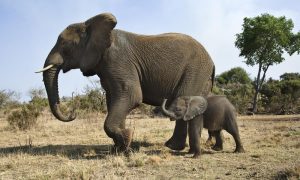
The hidden salt route in Africa
The sodium content in African plants varies extremely between regions. In some cases, the difference can be up to a thousand times greater from one area to another.
This inequality explains why certain territories sustain healthier populations than others. To compensate for the scarcity, animals have developed unique behaviors.
Elephants dig in riverbeds or enter caves to access salt-rich rocks. Meanwhile, rhinoceroses, zebras, and antelopes concentrate in natural desert salt pans.
These points become key ecological nodes. They influence not only diet but also migration and regional distribution of wildlife. The search for sodium traces invisible routes on the African map.
Health, behavior, and ecological balance
The lack of sodium affects animals with larger body sizes more strongly. In them, the deficit can lead to physiological stress and lower overall condition. This impacts reproduction and population stability.
Behavioral changes are also noticeable. The need for salt drives longer and more frequent movements. In some cases, animals are forced to leave safe areas.
Understanding this nutritional factor is key to interpreting the dynamics of ecosystems. Diet not only feeds but also organizes wildlife. And in the case of megaherbivores, salt plays a silent but decisive role.
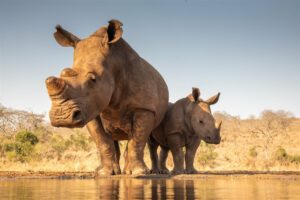
Threats that exacerbate the scarcity of sodium, an invisible but fundamental mineral
Landscape transformation is one of the main threats. Agricultural expansion, mining, and infrastructure alter soils and natural salt sources. This reduces wildlife access to an already limited resource.
Climate change also influences the availability of the mineral. Changes in rainfall and temperatures affect plant composition. As a result, the sodium present in the plant diet decreases even further.
Added to this is the conflict with human activities. Roads, artificial wells, and populated areas attract animals in search of salt. The result is greater risks, forced displacements, and tensions with communities.
A challenge for the conservation of the future of African giants
Protecting African large herbivores involves looking beyond water and vegetation. Land management must consider the distribution of essential nutrients. Salt, though invisible, is a central part of the ecological balance.
Incorporating this knowledge can improve conservation strategies. Ensuring natural access to sodium reduces risky movements and improves animal health. Caring for the minerals in the landscape is also caring for its giants.
The survival of elephants, giraffes, and rhinoceroses depends on subtle factors. Understanding them is key to sustaining the African biodiversity. In the savannah, even a small mineral can make a difference.

