



At the United Nations General Assembly in New York, Donald Trump once again questioned the reality of climate change. The U.S. president dedicated a large part of his speech to ridicule the energy transition and international policies against global warming.
In front of world leaders, he labeled the climate crisis as a hoax and attacked renewable energies, calling them a “joke”. He also targeted China and the United Kingdom, stating that their investments in clean energy were “pathetic” and that they should increase oil production.
The speech coincided with the Climate Week in New York and took place a few weeks before COP30 in Brazil. The intervention raised alarms coming from one of the countries that contribute the most to greenhouse gas emissions. Furthermore, it highlighted the lack of environmental commitment from the current administration.
The statements contrast with available data. China leads in clean energy capacity, with more than triple the wind power capacity than the United States. The United Kingdom, on the other hand, obtains almost a third of its electricity from wind sources. Meanwhile, the United States is regressing in its green investment, weakening its role in the global climate fight.
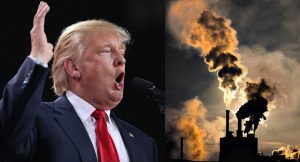 Donald Trump denies the environmental crisis.
Environmental Policy in the United States: Setbacks and Challenges
U.S. environmental policy is going through a period of strong tensions. During Joe Biden‘s administration, tax incentives for renewable energies were approved, electric vehicles were promoted, and the national climate agenda was strengthened. However, with the Congress in Republican hands, many of these measures were weakened.
Trump prioritized the export of fossil fuels and cut benefits for clean technologies. This not only compromises the progress made in emissions reduction but also puts the country at a disadvantage compared to leading powers in the energy transition.
The political shift affects both the green industry and international confidence in the United States’ climate commitment. At the same time, it creates uncertainty among investors seeking stability to invest in sustainable projects. The oscillation between opposing policies depending on the administration reflects a lack of continuity that impacts the achievement of global goals.
 Trump not only denies the climate crisis but also discredits the role of renewable energies. (Photo: Reuters).
States Joining the Fight Against Climate Change
Despite these setbacks, civil society and several states in the country continue to promote mitigation measures. Cities like New York and California are advancing their own regulatory frameworks to reduce emissions and promote the transition to renewable energies. This highlights a gap between local efforts and federal strategy.
The immediate challenge for the United States is to decide whether it will maintain an environmental policy aligned with international commitments or continue to regress in favor of fossil fuels. What is at stake is not only its leadership in the climate fight, but also the future of global ecosystems that depend on urgent and sustained action.



