



The massive arrival of sargassum in the Mexican Caribbean has triggered new environmental alerts. Researchers from the College of the Southern Border are advancing their study through drone monitoring systems.
Using RGB and multispectral technology, specialists analyze the impact of the algae on the water. Consequently, they seek to determine whether the nutrients detected come from its decomposition or from underground pollutants.
Additionally, this approach allows for more precise observation of the coastal dynamics. Therefore, it becomes a key tool for understanding the degradation of marine ecosystems.

Technology applied to understand an expanding environmental crisis
The use of drones allows for surveying extensive areas with high precision. In this way, sargassum accumulations are identified in critical points of the coast.
Likewise, the flights are conducted under specific protocols that ensure reliable data. This enables the construction of predictive models about the arrival and behavior of these macroalgae.
In parallel, the system allows differentiation between sargassum tides and pollution plumes. Consequently, a more comprehensive reading of the ongoing environmental processes is achieved.
At the same time, this information is crucial for scientific, tourism, and productive sectors. Thus, it strengthens decision-making in the face of a growing problem.
Affected areas and visible effects on the coastal ecosystem
The most severe consequences are recorded in locations such as Mahahual and Xahuayxol. There, the biomass accumulation reaches strips of up to 25 meters.
As a result, the decomposing sargassum releases leachates and toxic gases. These compounds alter the water quality and create adverse conditions for marine life.
On the other hand, a significant decrease in seagrasses has been detected. Consequently, species that depended on these habitats disappear or migrate.
Meanwhile, in Puerto Morelos, cleaning and containment tasks are being implemented. However, in other areas, the accumulation persists, worsening the environmental damage.
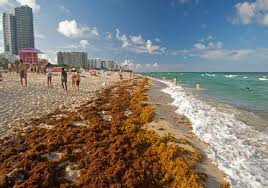
The ecological impact of sargassum on marine ecosystems
Sargassum fulfills ecological functions in the open sea, but its excessive accumulation on the coast creates imbalances. Firstly, its decomposition consumes dissolved oxygen in the water.
Additionally, this process releases substances that alter the chemistry of the environment. As a result, hypoxic conditions are generated that affect fish and invertebrates.
Moreover, the gases emitted, such as hydrogen sulfide, impact both fauna and human health. This turns the phenomenon into an environmental and health problem.
Furthermore, the massive coverage of sargassum blocks sunlight. Consequently, it hinders photosynthesis of organisms such as seagrasses and corals.
Finally, the loss of biodiversity and the alteration of trophic chains reflect a long-term impact. Therefore, understanding and managing this phenomenon is key to the conservation of the ecosystem.



