



Michoacán, one of the states with the highest incidence of forest fires in Mexico, implemented an innovative strategy to recover its forests: the use of drones to disperse pre-germinated seeds for aerial reforestation. With this initiative, they aim to restore areas where human access is nearly impossible and accelerate the reforestation processes.
The year 2024 was one of the most critical in terms of fires for the country. According to official figures, more than 1.6 million hectares were affected in different regions, leaving devastated soils and fragmented ecosystems. Michoacán was among the most impacted territories, with tens of thousands of hectares ravaged by the fire.
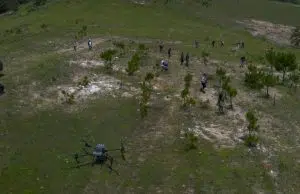
The drones, capable of carrying up to 20 kilograms of seeds in each flight, proved to be an effective tool. By spreading pre-germinated material—seeds with incipient roots ready to grow—the probability of vegetation regrowth in areas where natural regeneration would be too slow is significantly increased.
This strategy does not replace traditional reforestation methods, but complements them. In areas inaccessible to firefighters and volunteers, aerial technology becomes a crucial ally. Thus, the goal is to accelerate the recovery of forests that would otherwise take decades to regenerate.
Reforestation with Drones: Technology at the Service of Nature
The magnitude of forest fires in Michoacán is alarming. In 2024 alone, more than 97,000 hectares were consumed by fire. So far in 2025, nearly 36,000 hectares have been reported, confirming that the problem remains serious and demands quick and sustainable responses.
The operation of the drone is simple yet powerful: by releasing the seeds from a certain height, the wind helps to disperse them evenly, covering large areas in a short time. This process is particularly valuable in mountainous areas or with restricted access, where transporting young trees or planting tools manually would be unfeasible.
Furthermore, local communities actively participate in the program. In many cases, they provide the seeds and collaborate in traditional reforestation, strengthening the relationship between technology and community action. Thus, aerial work is complemented by ground efforts, creating a comprehensive front against forest cover loss.
Although the germination expectation is around 30%, it is a relevant percentage considering the amount of seeds distributed each day. The cumulative impact can result in thousands of new trees in a matter of years.
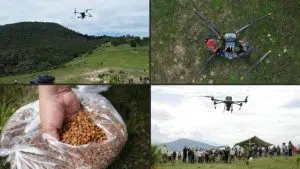 Mexico uses drones to reforest areas destroyed by fires. Photo: AFP/Enrique Castro.
The Environmental Benefits of Green Technology
The use of drones in reforestation not only represents efficiency but also an alternative with multiple ecological benefits. By reducing the time needed to cover large extensions, the restoration of ecosystems essential for carbon capture, climate regulation, and biodiversity protection is accelerated.
Another environmental benefit is the reduction in the use of logistical and human resources. While manual planting requires extensive travel, material transport, and a significant energy investment, aerial seeding reduces the process’s carbon footprint and optimizes efforts.
Additionally, by seeding immediately after a fire, soil erosion is prevented and the regeneration of vegetative cover is favored, thus preventing landslides and the loss of essential nutrients. The forest’s restoration not only protects local flora and fauna but also the human communities depending on these resources for their livelihood.
The use of drones in reforestation also serves as an example of how technology can be used in favor of the environment. Instead of being seen solely as a source of negative impact, technological innovation offers alternatives to mitigate the climate crisis and accelerate ecological recovery processes.



