



The forest fires have once again set off alarms in the Brazilian Amazon. In February, 873 active fires were recorded, representing an increase of 118.7% compared to the same month in 2025.
The data was released by the National Institute for Space Research, which monitors the forest using satellite images. However, despite the strong year-on-year increase, the number of fires fell by 57.5% compared to January.
This irregular behavior reflects the fragility of the Amazon ecosystem in the face of human activities. It also demonstrates how land use changes continue to be one of the main threats to the largest tropical forest on the planet.
At the same time, Brazilian authorities continue to strengthen strategies to reduce environmental pressure on the region.
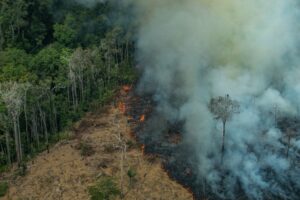
Deforestation, illegal mining, and agricultural expansion behind the spread of fire
A large part of the fires recorded in the Amazon do not occur naturally. On the contrary, many are linked to the burning of vegetation to open new areas for livestock or agriculture.
This is compounded by the expansion of illegal activities such as mining and illegal logging. These practices degrade the forest and create vulnerable areas where fire can spread more easily.
During Jair Bolsonaro’s government, various environmental studies recorded a significant increase in these activities in the forest. As a result, deforestation advanced over large areas of the Amazon territory.
Subsequently, the current president Luiz Inácio Lula da Silva promoted an agenda focused on the environmental recovery of the region. Among the main measures are strengthening controls and prosecuting illegal extractive activities.
Operations against illegal mining in indigenous territories
One of the main focuses of environmental policies is the protection of indigenous territories. In particular, the Brazilian government intensified actions in the land of the Yanomami people.
In that region, a serious health and humanitarian crisis linked to illegal gold mining was detected. The clandestine extraction caused river pollution, forest destruction, and a strong impact on local communities.
In response to this scenario, the State deployed operations to expel illegal miners and regain control of the territory. According to official reports, the actions managed to reduce this activity by 99% within the protected area.
However, experience shows that the prolonged absence of controls can facilitate the return of these practices. Therefore, the challenge now is to maintain a permanent presence that ensures the conservation of the forest.

How do fires in the Brazilian Amazon affect the global environment?
The fires in the Amazon have consequences that go far beyond Brazil. The forest functions as one of the largest climate regulators on the planet and plays a key role in absorbing carbon dioxide.
When large areas of forest burn, enormous amounts of carbon stored in the vegetation are released into the atmosphere. This contributes to global warming and accelerates the processes associated with climate change.
Additionally, the smoke generated by the fires can travel thousands of kilometers and alter regional climate patterns. It can even affect the air quality in distant cities.
Finally, the loss of forest implies the disappearance of habitats for thousands of plant and animal species. Thus, each fire not only destroys vegetation but also weakens one of the most important ecosystems for the environmental balance of the planet.


