



For several months now, different districts of the Southwest of Buenos Aires have been participating in an ecological project of continental reach that proposes rethinking the relationship between people and the environment: a green route.
Based on local actions, the initiative seeks to revalue native plants and promote their recovery in the territories where they evolved.
The proposal is part of a network that crosses America from north to south. In this context, each local action is integrated into a larger vision, aimed at restoring biodiversity and strengthening environmental awareness from everyday life.
Thus, environmental care ceases to be an abstract idea and becomes a concrete practice, close and collective.
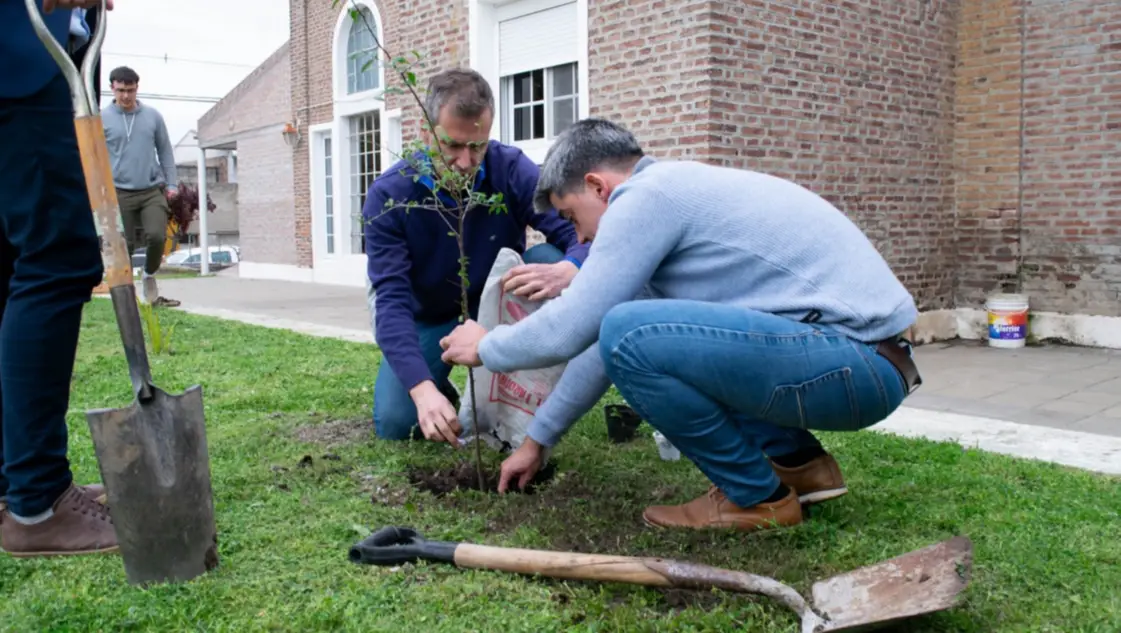
A green corridor built from the local
The Green Route is promoted nationally by Red Solidaria Argentina, while at the regional level it has the support of the Provincial University of the Southwest.
The main objective is to create a continuous biocorridor, from Alaska to Tierra del Fuego, composed exclusively of native species from each subregion.
This corridor is not materialized with large works, but through small community interventions. Therefore, neighbors, schools, universities, and organizations can create the so-called “green tiles”, spaces where native plants are cultivated and cared for.
Each tile is georeferenced and registered on digital platforms, allowing the collective effort to be visualized and building a living map of environmental conservation on a continental scale.
Biodiversity and species of the Southwest of Buenos Aires
In the Southwest of Buenos Aires, the initiative adapts to the ecological particularities of the territory. There, the planting of eight native species is promoted, corresponding to two well-defined subregions.
In the Pampas Steppe, the Sombra del toro, Poa, Chañar, and Espinillo stand out. Meanwhile, in the Monte region, Cardón, Molle, Arampu, and Jarilla are prioritized, all key species for the balance of the local ecosystem.
Various municipalities have already joined with actions in plazas, schools, parks, and public spaces. Additionally, many institutions promote these practices autonomously, reinforcing the community character of the project.
Environmental education and institutional commitment
The Provincial University of the Southwest supports the Green Route as part of the activities for its 25th anniversary. In this process, progress has been made in the incorporation of native species in several of its campuses, with the idea of integrating nature and education.
At the same time, teachers and researchers promote the scientific value of native plants as allies against climate change. These species improve soil quality, favor water infiltration, and provide food and shelter to local fauna.
In this way, each green tile acts as a small open-air laboratory, where natural processes are regenerated and environmental learning is strengthened.

What are the advantages of a continental green network?
The Green Route provides direct environmental benefits, such as the restoration of biodiversity and the creation of biological corridors that facilitate the movement of birds and insects. At the same time, it helps reduce the impact of climate change through carbon capture and soil improvement.
On the social level, the initiative strengthens the sense of belonging and community work, while transforming urban and rural spaces into healthier environments. Additionally, it promotes responsible consumption decisions, encouraging the use of native plants over exotic species.
Finally, by integrating into a continental map, each local action acquires a greater dimension. Thus, small green tiles become key pieces of a collective, concrete, and sustained response to the environmental challenges of the present.


