



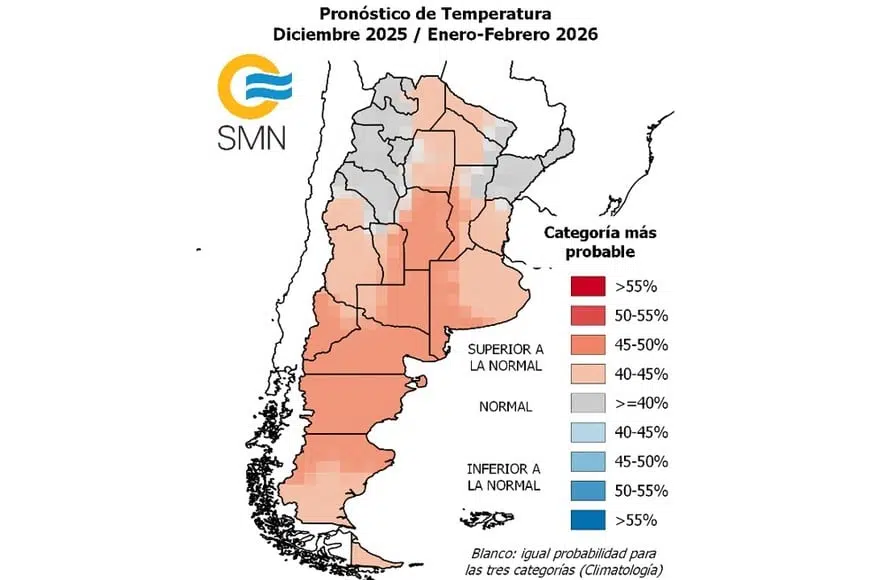
The National Meteorological Service (SMN) anticipates that the months of December, January, and February will be dominated by heatwaves in much of the country.
The maps of the quarterly forecast show a predominance of warm colors, from pale pink to intense tones, reflecting the probability of a more extreme summer than usual.
What is a heatwave?
Although heat is typical of summer, the concern arises when temperatures exceed the tolerable thresholds for human health for at least three consecutive days. This phenomenon is defined as a “heatwave”.
The thresholds vary by region:
- Santa Fe: 34.6 °C maximum and 22 °C minimum.
- Córdoba: 34.6 °C / 20.5 °C.
- City of Buenos Aires (CABA): 33 °C / 22 °C.
In CABA, the December 2013 heatwave caused a 43% increase in mortality, being the longest since records exist.
A phenomenon increasing since 1960
According to CONICET researcher Matilde Rusticucci, heatwaves have become more frequent in Argentina since 1960, as a consequence of climate change.
- In CABA, 19 of the last 20 summers had at least one heatwave.
- In Mendoza, extreme heat days have tripled in the last decade compared to the 2000-2010 period.
The health risk is evident: between 2005 and 2019, people in major Argentine cities had between 8% and 25% higher risk of dying from the effects of a heatwave.
Impacts on health and society
Extreme heat is considered by the World Meteorological Organization as the most lethal climate phenomenon globally, responsible for more than 546,000 deaths per year.
The effects include:
- Increased vulnerability in young children, the elderly, and pregnant women.
- Complications for those with chronic diseases, disabilities, or electrical dependency.
- Elevated risk for people living on the streets or in precarious housing without access to safe water.
- Less visible impacts: male infertility, premature births, low birth weight, and child malnutrition.
Additionally, extreme heat affects energy, water, and transportation systems, exacerbates urban heat islands, and reduces work performance.
Early warnings and prevention
Since 2019, the SMN has incorporated the concept of heatwaves into its early warning system. The advisories are published daily and classified by colors:
- Yellow: slight danger for the general population, moderate for risk groups.
- Orange: moderate to high effect, very dangerous for vulnerable groups.
- Red: very dangerous, even for healthy people.
Actions in Argentine cities
The program “Heatwaves and the health of the elderly in Argentine cities”, coordinated by CIPPEC with support from Wellcome Trust and LIECS, works in Rosario, Córdoba, Mendoza, Tucumán, Buenos Aires, and Greater Resistencia.
Examples of local measures:
- Rosario: geolocation of public drinking fountains and climate shelters in mobility applications.
- Córdoba: launch of the Action Plan for heatwaves with its own early warning system.
Recommendations for facing a heatwave
Experts emphasize basic but vital measures:
- Keep the house cool and ventilate at appropriate times.
- Wear light clothing, a cap, and sunscreen.
- Drink plenty of water.
- Do not leave people or pets in closed vehicles.
- Activate care networks, especially for elderly people living alone.
Warning symptoms include:
- Mild: rash, cramps, leg swelling.
- Moderate: headache, dizziness, nausea, intense sweating.
- Severe: dry skin, body temperature >40 °C, loss of consciousness, heart alterations.
Heatwaves are a “silent killer” that intensifies with climate change. Argentina faces a growing challenge: protecting vulnerable populations, adapting cities, and raising awareness about a phenomenon that is already the deadliest on the planet.



