



In February 1600, South America was the scene of the largest volcanic eruption recorded in its history. The protagonist was the Andean volcano Huaynaputina, located in southern Peru, whose explosion even surpassed that of Vesuvius.
From the Andean heights, the eruption released such an amount of ashes and gases that its effects transcended borders and continents. Thus, a local event ended up altering the global climate.
This extreme episode left deep marks both in the regional ecosystems and in the environmental history of the planet.
The eruption that changed the climate
The Huaynaputina erupted on February 19, 1600, and launched an eruptive column that exceeded 30 kilometers in height. As a result, enormous volumes of volcanic material reached the upper atmosphere.
The ashes dispersed for months and reached regions as far away as Canada. At the same time, volcanic particles remained suspended, modifying solar radiation.
Consequently, there was a drop in temperatures in large areas of the Northern Hemisphere, which directly impacted agricultural cycles.

Environmental and social impact in the Andes
Locally, the regions of Moquegua, Arequipa, and Tacna were the most affected. The pyroclastic flows buried entire towns and irreversibly transformed the landscape.
Additionally, the contamination of the Tambo River altered key aquatic ecosystems, affecting the availability of water and food. Thus, the eruption combined natural disaster and environmental crisis.
For weeks, entire cities were covered by ash, with dark skies that altered daily life and natural rhythms.
A phenomenon with global consequences
Beyond South America, the effects were felt in Europe and Asia. In Russia and Germany, the decrease in temperatures reduced agricultural production, generating prolonged famines.
This phenomenon demonstrated how a volcanic eruption can alter interconnected climatic systems. Thus, the Huaynaputina became an emblematic case of global environmental impact. Centuries later, ash remnants found in Canadian trees confirmed the planetary reach of the event.
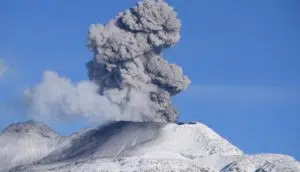
Characteristics of the Huaynaputina volcano
The Huaynaputina rises about 4,850 meters above sea level and sits on a volcanic plateau in southern Peru. Its name, of Quechua origin, means “young volcano”.
It is an explosive volcano, with a large crater formed after the 1600 eruption, located over 4,200 meters high. Its structure favors highly energetic eruptions.
Although it is currently in superficial calm, it remains active at an internal level, with frequent seismic records indicating magmatic movement.
Scientific monitoring and environmental prevention
Currently, the volcano is permanently monitored by Peruvian scientific organizations. This monitoring allows understanding its behavior and anticipating possible eruptive scenarios.
Thanks to these studies, it is now possible to reduce environmental risks and protect nearby populations through evacuation plans and territorial planning.
Thus, the Huaynaputina is not only a symbol of the power of nature but also a warning about the importance of coexisting with it through knowledge and prevention.


