



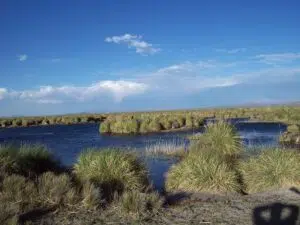
In the south of Mendoza, the Llancanelo lagoon appears as a serene landscape. However, beneath that stillness lies a vital ecological system for thousands of migratory birds.
Indeed, this wetland located in Malargüe functions as an essential stopover. There, species find food and rest before resuming journeys that exceed 16,000 kilometers across the continent.
Therefore, its relevance exceeds the local. Llancanelo acts as a node within a natural network that connects ecosystems throughout the Americas, supporting essential biological processes.
International recognition and scientific value
The lagoon was incorporated into the Western Hemisphere Shorebird Reserve Network, a system that brings together strategic sites for the conservation of migratory birds.
Moreover, this designation is supported by scientific evidence. Various studies confirmed that the wetland maintains key populations during the migratory cycles, consolidating its role in continental routes.
In particular, the presence of Baird’s sandpiper was decisive. The records exceeded 1% of its global population, with more than 5,400 individuals, an indicator that positions the site as strategic on a global scale.
Thus, inclusion in this network not only recognizes its biodiversity. It also promotes new conservation strategies and international cooperation.
Conservation with local participation
The incorporation was presented at the Thesaurus Convention Center, where a commitment was signed between public agencies and environmental organizations.
Consequently, action lines were established aimed at protecting the ecosystem. Among them, the planning of area use and the promotion of sustainable practices stand out.
Likewise, there is an effort to strengthen the bond with the community. Conservation ceases to be only technical and integrates into educational, productive, and recreational activities.

How to get there and enjoy ecotourism
Getting to Llancanelo involves traveling to Malargüe, in southern Mendoza. From there, access is via provincial routes leading to the reserve, on a journey that traverses arid and volcanic landscapes.
On the other hand, the area is regulated, so it is advisable to coordinate visits with authorized guides. This ensures both safety and the care of the natural environment.
Regarding the experience, ecotourism offers multiple options. Bird watching is the main activity, especially during migratory seasons.
Additionally, visitors can explore trails, engage in nature photography, and participate in educational proposals. All under a responsible approach that minimizes the environmental impact.
In this way, Llancanelo is consolidated as a destination where conservation and tourism converge. Its international recognition reinforces not only its ecological value but also its potential as a space for sustainable development.



