



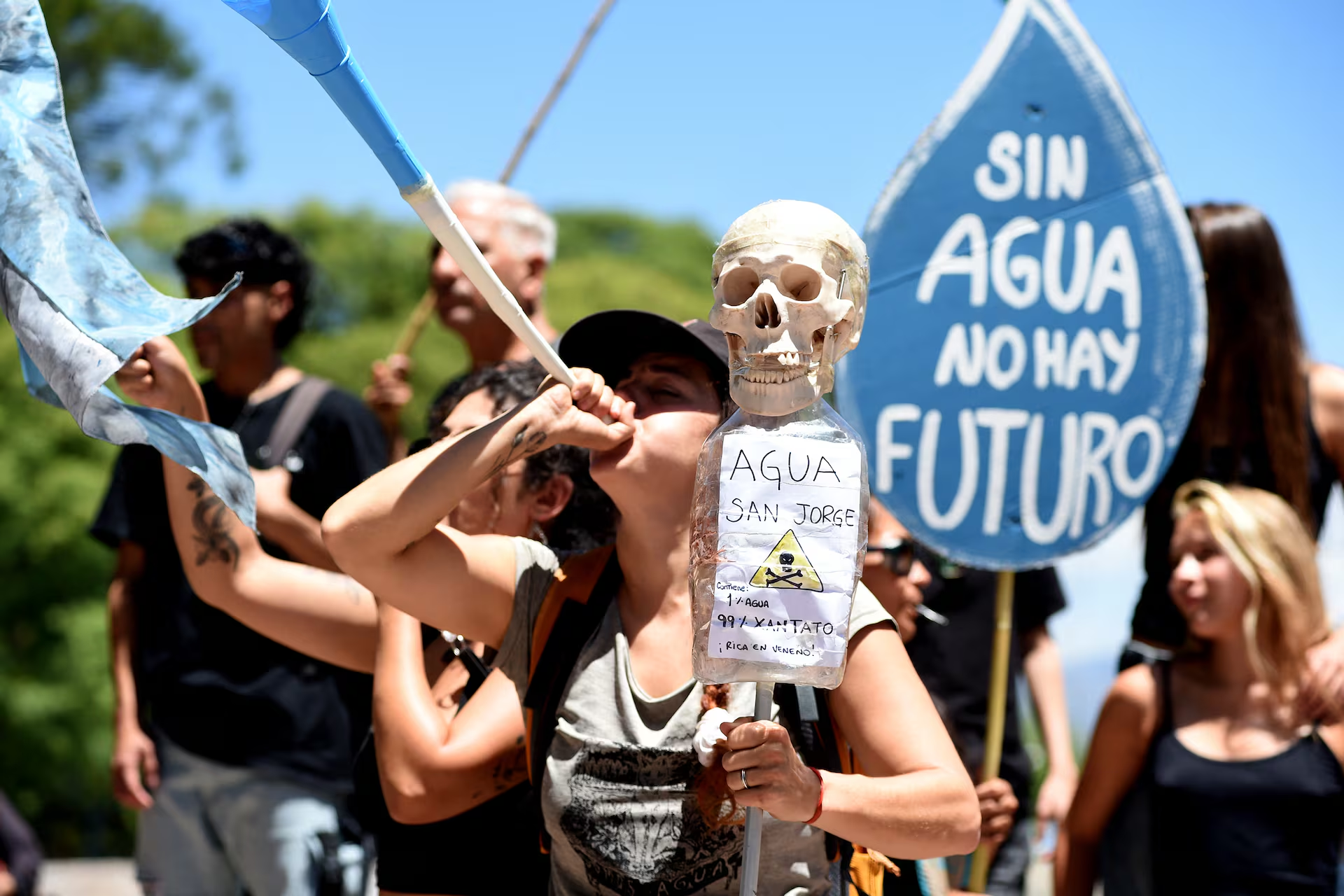
Hundreds of people staged a protest in Mendoza on Tuesday, December 23, to reject the recent mining projects approved in the province.
Weeks ago, the Mendoza Legislature approved the controversial San Jorge copper project and other mining initiatives.
The approval came despite the rejection of socio-environmental assemblies and social organizations throughout the province.
Therefore, this Tuesday, a protest was organized in Mendoza that covered more than seven blocks, from the center to the Government House.
Protesters from at least 15 regions of Mendoza converged under the slogan “water is not negotiable”.
There, they demanded Governor Alfredo Cornejo repeal the two recently approved laws.
The demonstration began around 10:30 at Kilometer Zero, in Plaza Belgrano, and included numerous self-convened neighbors.
The mining projects in Mendoza questioned in the protest
Tuesday’s demonstrations aimed at the repeal of provincial laws 9.684 and 9.685.
These enabled the environmental impact statements for various mining exploitation projects in the province.
In particular, it concerns the copper project on San Jorge hill, located in Uspallata, and about thirty extractive initiatives in Malargüe.
The PSJ Cobre Mendocino project, formerly known as the San Jorge mine, generates particular concern as it is an open-pit operation.
The initiative is currently in the hands of the Swiss company Zonda Metals GmBH along with the Alberdi Group.
In 2011, the provincial Legislature had already discarded this project due to its environmental impact in a sensitive water zone.
The controversy over chemical substances
Tuesday’s protest reaffirmed the Law 7722, enacted in 2007 in Mendoza following a strong social mobilization.
This law prohibits the use of toxic substances such as cyanide and mercury in metal mining.
However, the provincial government argues that the chemicals provided for in the project would not be covered by that prohibition.
Among these substances are:
- Methyl Isobutyl Carbinol
- Sodium Isobutyl Xanthate
- Anionic Polyacrylamide
- Calcium Oxide

Socio-environmental assemblies completely reject this interpretation, as they consider that any chemical substance used in mega-mining poses a risk to water and the province’s ecosystems.
However, Governor Cornejo downplayed the water impact of mining activity.
Currently, with the support of the National Government, he maintains that the greatest water consumption comes from the agricultural sector and residential use.
“The problem does not lie in mining, but in waste,” he stated, a phrase that generated strong rejection among the mobilized sectors.
The historical symbolism and a key date
The date chosen for the protests in Mendoza refers to the massive mobilizations of 2019.
That year, then-Governor Rodolfo Suárez attempted to modify Law 7722 and had to backtrack after a wave of protests.
From that process emerged the “Day of the Parientazo,” centered in the Uco Valley.
Participants evoked the figure of General José de San Martín and defined the day as a “patriotic feat for water.”
That territory has deep historical significance: there San Martín met with the Pehuenche peoples before crossing the Andes.
The Mendoza assemblies take up that legacy to promote what they define as a new “liberating feat,” this time in defense of water against the advance of mega-mining.


