



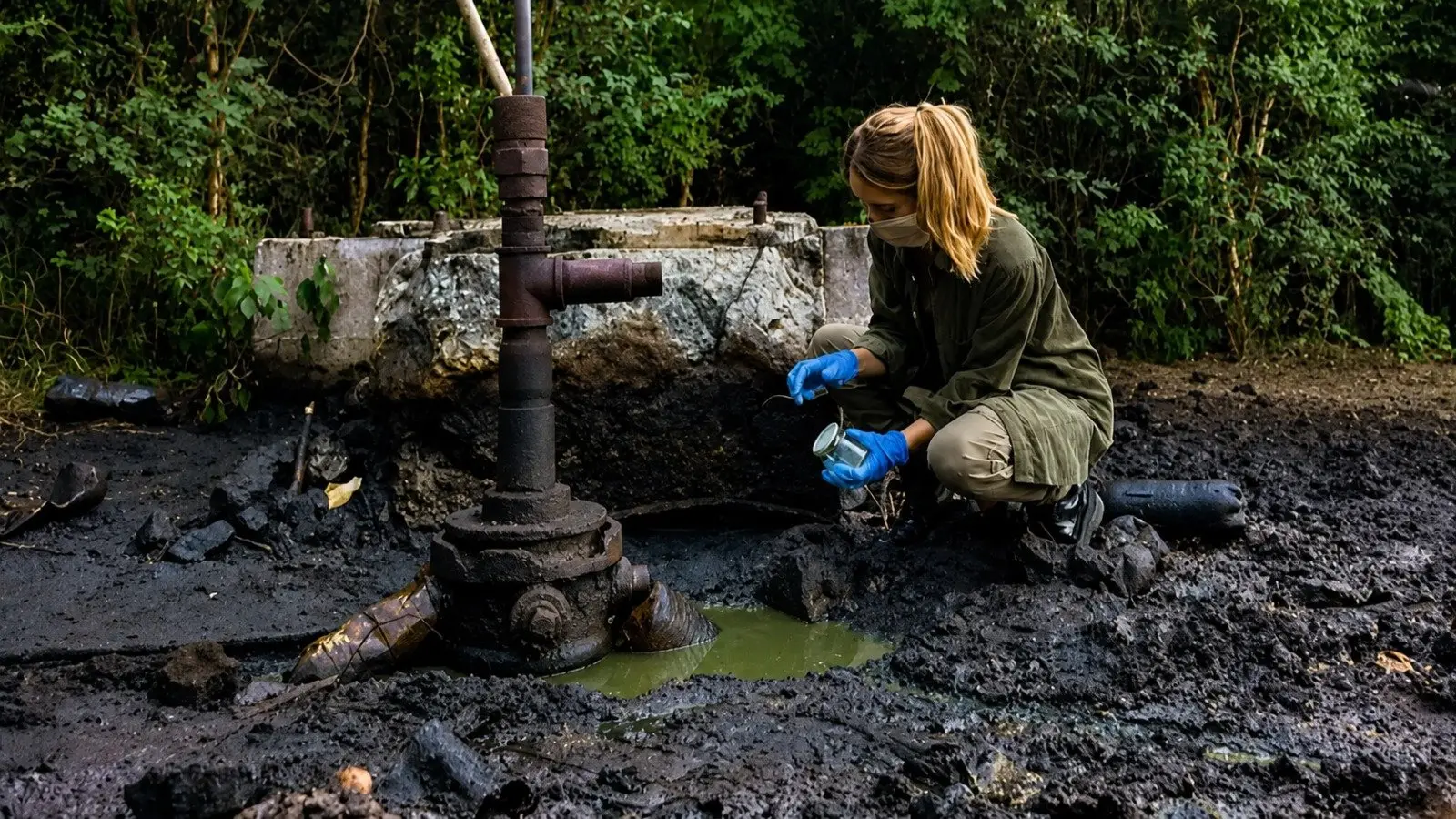
The contaminant leaks from an inactive deposit in the Aguaragüe area, a region of yungas in Campamento Vespucio (General Mosconi), have once again brought to the forefront the debate on oil wells without definitive abandonment. Deputy Nicolás Arce, from the San Martín department, took soil samples that are being analyzed by the Yaculab laboratory in Tartagal to determine the composition of the seepages and their environmental impact.
This incident adds to other serious precedents: the LO-X10 well in Lomas de Olmedo, inactive since the eighties, has been out of control for almost three years with leaks affecting soils, aquifers, flora, wildlife, and livestock.
Background of similar disasters
- Puesto Guardián (MDT-14): violent hydrocarbon eruptions in 2006, sealed only in 2012 after six years of work and a cost of 30 million dollars assumed by YPF.
- Privatization of 1991: the area was awarded to private companies (EPP, Tripetrol, Netherfield), with successive transfers until President Petroleum became the sole owner in 2014. The firm went into administration in 2024 and was declared bankrupt in 2015.
These precedents show a chain of private operators who neglected technical and legal responsibilities, leaving environmental liabilities that remain active today.
Magnitude of the problem
The Minister of Production, Ignacio Lupión, reported in April that there are about 1,400 oil wells in the province, of which only about fifty produce crude oil. The rest remain without the sealing that the regulations define as definitive abandonment, becoming environmental time bombs.
The legislative perspective
Deputy Nicolás Arce, from Libertad Avanza, presented legislative projects to address this issue. He pointed out that spills are not only an environmental problem but also a reflection of years of lack of control, investment, and planning:
“We understand that these environmental liabilities do not disappear on their own. They need constant monitoring, proper technical abandonment, and real controls to prevent impacts from continuing to advance on the soil, water, and communities.”
Arce also emphasized that the abandonment and remediation of wells could become a genuine job opportunity: opening roads, installing work sites, taking samples, and technical tasks that would generate dozens of direct and indirect jobs in the northern province.
Criticism of management
The deputy criticized the lack of serious control and remediation policies:
- The Province collected royalties but did not control or oversee the companies.
- Decision-making positions in energy were never occupied by local specialists.
- There is still a late reaction to situations that should have been prevented.
Local companies with capacity
Arce highlighted that the San Martín department has firms such as Producer, Servimax, Geocor, Tecmec, M&P, Geominera, Yaculab, Suministros y Talleres Norte, among others, with sufficient experience to intervene in the technical abandonment of wells.
Oil wells without definitive abandonment in Salta represent a significant environmental and social risk. Without clear control and remediation policies, spills will continue to occur. At the same time, their remediation could become a lever for local employment, transforming an environmental liability into an opportunity for regional development.


