



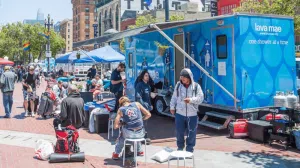
The reuse of disused materials once again demonstrated its environmental potential and social impact through an initiative born in the United States. In the city of San Francisco, old buses retired from the transport system were converted into mobile showers for homeless people.
The project, known as Lava Mae, emerged in 2013 and quickly gained attention for combining recycling, social inclusion, and urban infrastructure recovery. From units that were no longer used, a mobile basic hygiene system was developed that today inspires similar proposals in different countries.
In addition to reducing bulky waste, the experience allowed the reuse of vehicles that would otherwise have ended up abandoned or turned into scrap. Thus, the initiative managed to give a second useful life to industrial structures through a sustainable approach.
How the proposal was born in San Francisco
The creator of the project was Doniece Sandoval, a former worker in the hotel industry who observed the growing population without access to basic services in San Francisco. The lack of showers and public restrooms motivated the search for a concrete and quickly implementable solution.
At the same time, the city was advancing with the replacement of old public transport buses. In this scenario, the idea arose to transform these units into mobile equipped spaces for personal hygiene and social assistance.
Over time, the vehicles were completely remodeled to incorporate individual showers, bathrooms, sinks, and areas to change clothes. Additionally, volunteers began distributing hygiene kits, clean clothes, and essential items to those living on the street.
The proposal allowed services to reach different neighborhoods and precarious settlements without the need to build permanent facilities. Therefore, the mobile system became a flexible and adaptable alternative to different urban contexts.
Recycling and circular economy applied to everyday life
The conversion of buses into mobile showers represents a concrete example of circular economy. Instead of discarding large metal structures, the project reuses already manufactured resources and reduces the consumption of new materials.
At the same time, the initiative reduces the environmental impact associated with the accumulation of industrial waste. The recycled buses avoid polluting processes linked to the final disposal of out-of-use vehicles.
Moreover, the system demonstrates that sustainability can also be applied to social policies. The combination of urban recycling and community assistance allows for the creation of more accessible and environmentally responsible solutions.
In cities with growing housing problems and high levels of waste, this type of experience opens new possibilities for efficiently reusing public infrastructure.

The environmental and social benefits of this initiative
One of the main contributions of the project is the reduction of large urban waste. Refurbishing buses decreases the need to manufacture new structures and avoids a high consumption of energy and raw materials.
Additionally, mobile showers help improve public health and the sanitary conditions of thousands of people. Access to water and hygiene spaces is essential to prevent diseases and strengthen human dignity.
In turn, the proposal promotes environmental awareness by showing that discarded objects can become useful tools for the community. This approach encourages replicable reuse models in other cities.
The experience also fosters collaborative work between social organizations, volunteers, and local governments. Thanks to this collaboration, similar initiatives have begun to expand to Australia, New Zealand, Mexico, and Hawaii.
A sustainable model already replicated in different countries
Over the years, Lava Mae has become an international example of ecological and social innovation. The organization claims to have inspired more than 100 mobile hygiene programs in different regions of the world.
The proposal demonstrates that the reuse of materials can become an effective tool against complex urban problems. Additionally, it highlights how the circular economy can be integrated into community assistance projects.
While many cities seek sustainable alternatives to reduce waste and improve quality of life, bus recycling appears as a concrete option to combine social inclusion, environmental recovery, and efficient resource use.


