



The Protestant Foundation Time to Act is driving an ambitious program of reforestation with native species in the province of Misiones. It is being carried out as a key tool against the climate crisis.
Under the name “Missionary Jungle Grows“, this initiative not only helps mitigate the effects of climate change, but also generates fundamental ecological benefits for the region.
Among the most outstanding contributions of the program are the improvement in water quality, erosion control, soil enrichment with organic matter, and biodiversity protection. This is achieved through ecological connectivity between forested areas.
Over 178 thousand trees to restore the Misiones jungle
Romario Dohmann, the program coordinator in the province, explained to argentinambiental.com that the project started in 2020, in an adverse context marked by the pandemic and one of the worst droughts recorded in the province.
Despite the difficulties, in just three years they managed to plant 178,000 native trees belonging to more than 30 different species, including fruit trees, timber trees, honey plants, medicinal plants, and ornamentals.
The reforestation focused especially on protecting water sources and recovering areas affected by forest fires, managing to afforest a total of 395 hectares between 2020 and 2022.
 Reforestation against climate change.
These actions were made possible thanks to the financing from international cooperation, local donors, private companies, and the support of faith communities linked to the Evangelical Church of the River Plate in Argentina, Paraguay, and Uruguay.
Environmental education to strengthen local commitment
The program also includes a strong commitment to environmental education, with awareness activities aimed at both producers and students. During the three years of the project, workshops were held in more than 25 schools, directly reaching 1813 people.
According to Dohmann, environmental restoration must go hand in hand with a social and educational focus. “It is unsustainable social behavior that acts on ecosystems at speeds that nature cannot keep up with,” he stated.
Local action is also reflected in the participation of 13 Guarani communities, who planted native species in their territories.
In addition, 340 rural families from 44 municipalities joined the initiative, seeking to make their productive systems more resilient and sustainable in the face of new climate challenges.
The Missionary Jungle Grows program directly contributes to the achievement of the Sustainable Development Goals (SDGs) of the 2030 Agenda, offering a concrete, local, and participatory response to the climate emergency.
How reforestation helps combat climate change
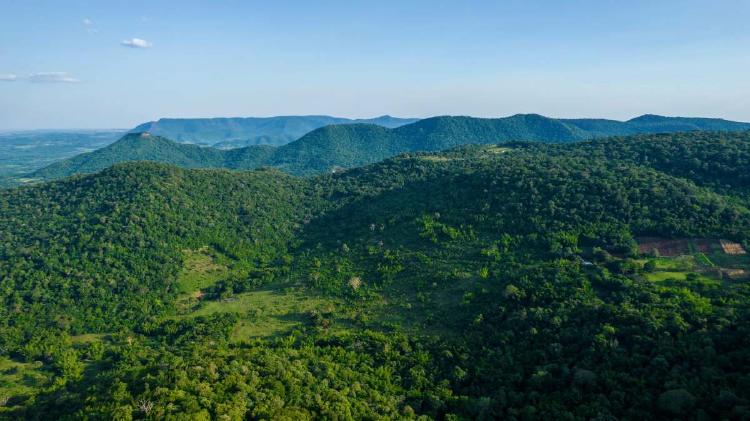 The importance of forests and reforestation.
Reforestation is a fundamental tool in the fight against climate change, and the benefits are manifold:
- Capture of carbon dioxide (CO2): trees absorb CO2, the main greenhouse gas, during photosynthesis. By planting more trees, the ecosystems’ capacity to capture atmospheric carbon and store it in their trunks, roots, and soil increases, reducing global warming.
- Local climate regulation: forests moderate temperature, increase humidity, and help maintain stable rainfall cycles. In areas affected by droughts or high temperatures, reforestation can improve the microclimate and reduce heat stress.
- Prevention of erosion and soil protection: trees help maintain soil structure, preventing its degradation and loss. Their vegetation cover slows down erosion caused by intense rains, something increasingly common with climate change.
- Protection of water sources: forests regulate the water cycle. They filter rainwater, recharge underground aquifers, and stabilize river and stream flows. This is vital in a context of global water crisis.



