



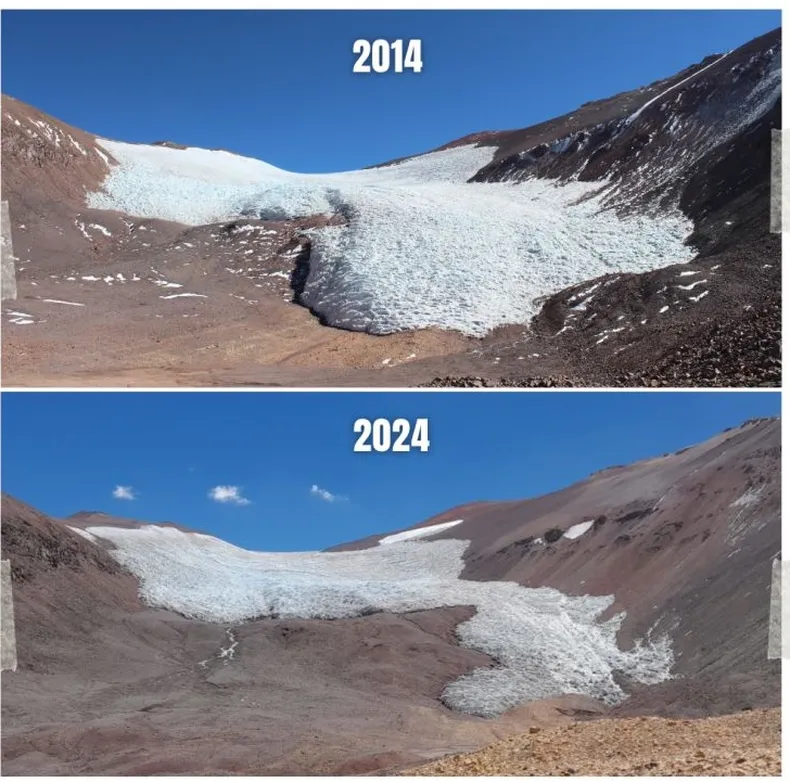
The Agua Negra Glacier, one of the most emblematic in the province of San Juan, is undergoing a process of accelerated deterioration that concerns the scientific community. According to the Argentine Institute of Snow, Glaciology, and Environmental Sciences (IANIGLA), between 2014 and 2024, the glacier lost about 9 meters of water equivalent, a retreat that reflects the fragility of the high mountain ecosystems.
This finding is particularly relevant for the province, whose water system depends largely on the contribution of snow and glaciers. The decrease in the thickness of Agua Negra not only represents a landscape change but also poses a direct risk to the water security of the population and the sustainability of local agriculture.
The glacier has been under annual monitoring since 2013 under the framework of the National Glacier Law. Strategically located near the international pass to La Serena, Chile, it is a reference in the study of glacier retreat in the Desert Andes. Its mass loss is an indicator of what could happen in other mountainous areas of the region.
At the beginning of 2025, a report had already warned that this glacier had lost 14% of its mass in the last decade. The new data confirms the continuation of this trend, which threatens to deepen if global temperatures continue to rise.
The causes of accelerated melting
The retreat of Agua Negra and other Andean glaciers is mainly due to climate change. The sustained increase in average temperatures accelerates the melting of ice, even in high mountain ecosystems that historically remained stable.
Another key factor is the variability in precipitation. The reduction in snowfall and changes in rainfall patterns result in less snow contribution to the glacier, preventing it from recovering the lost volume during warm summers. This imbalance in the mass balance progressively weakens its structure.
Atmospheric pollution also plays a role, especially from soot and dust particles that darken the ice surface. This phenomenon reduces its ability to reflect solar radiation and accelerates the melting. In mountainous areas near roads and mining activities, this impact is multiplied.
The result of these pressures is a progressive deterioration that affects not only the glacier as an ice body but the entire associated water basin. Glacier loss compromises water availability for irrigation, human consumption, and hydroelectric generation, and also alters unique ecosystems of the periglacial environment.

Agua Negra Glacier: a natural heritage at risk
Agua Negra is considered a reference glacier within the National Glacier Inventory. In 2013, it covered an area of just over one square kilometer, with a length of 2 kilometers and altitudes exceeding 5,200 meters. Its orientation and conditions make it a valuable scientific observatory.
The observed retreat adds to a disturbing forecast: if current trends continue, the glaciers in the region could lose up to 80% of their mass by 2100. This scenario would imply irreversible consequences for populations depending on melting water.
In a context where United Nations declared 2025 as the International Year of Glacier Conservation, the situation of Agua Negra reinforces the urgency of taking mitigation measures. Preserving these ice giants means ensuring water, biodiversity, and environmental balance for future generations.


