



Sand, silent and seemingly inexhaustible, is actually one of the most pressured resources by human activity. It is the second most used material in the world, after water, and its demand grows at the pace of cities that are rapidly building buildings, roads, and bridges.
In construction, its value is incalculable: it is the basis of concrete and glass, as well as being present in industrial and technological processes. However, this consumption boom has highlighted that sand is not infinite. Nature takes centuries to regenerate it, but current exploitation happens in a matter of days.
According to estimates from the UN Environment Program, around 50 billion tons of sand are consumed each year. To put it in perspective, it would be enough to build a wall 27 meters wide and high that surrounded the entire planet. A figure that alerts to the unsustainable pace at which it is being extracted.
Most worrying is that not all sand is suitable for industrial purposes. Desert sand is too fine and smooth, so large projects, even in arid countries, have had to import tons from other places, increasing the environmental and economic impacts of this market.
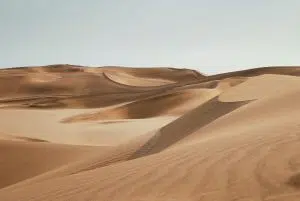 Sand, a natural resource at risk due to overexploitation. Photo: Unsplash.[/caption>
The ecological role of sand in nature
Beyond its industrial use, sand plays key ecological roles that often go unnoticed. On beaches and riverbanks, it acts as a natural defense against coastal erosion and protects communities from storms and high tides. When it is excessively extracted, this barrier weakens, exposing entire cities to the advance of the sea.
In rivers, sand regulates flows and maintains the stability of riverbeds. Its loss alters the water dynamics, accelerates sedimentation, and affects aquatic species that depend on these habitats to survive. Thus, indiscriminate extraction has a direct impact on biodiversity.
Wetlands and lagoons also depend on the presence of sand to maintain their balance. There, it acts as a natural filter, regulating water quality and supporting the flora and fauna that inhabit these ecosystems. Its disappearance not only affects the environment but also the human communities that obtain water and food from them.
Between illegality and innovation
The high value of the resource has given rise to a parallel market controlled by criminal networks. It is estimated that around 80% of the sand traded worldwide comes from unknown sources. In Brazil, this illegal trafficking moved around 4 billion dollars in 2021, reflecting a business that thrives in the shadow of global construction.
The most disproportionate consumption occurred in China, a country that for years used more than half of the world’s sand. Just between 2006 and 2016, it used more cement than the United States throughout the entire 20th century. Although a large part of their current demand is met with artificial sand obtained by crushing rocks and recycling debris, the damage has already been done.
Some initiatives show alternative paths. In India, university research has shown that recycled plastic can replace some of the sand in concrete. In Latin America, Mexico City passed a law in 2024 requiring the reuse of construction waste, generating recycled sand and reducing pressure on rivers and lakes.
 Sand, a natural resource at risk due to overexploitation. Photo: Unsplash.[/caption>
A look towards the future
The sand crisis raises the need to rethink how construction is carried out. While technological advances offer solutions, there still exists a huge dependence on a limited resource that is essential for ecosystems.
Experts point out that the challenge lies in balancing urban development with environmental protection. The cities of the future must opt for alternative materials, more robust recycling systems, and responsible resource management.
Sand, more than just a grain beneath our feet, is a pillar of modern life and natural ecosystems. Its protection is urgent to prevent what seems abundant today from becoming an irreparable absence tomorrow.



