



A protest against air pollution in India ended in repression in front of the iconic India Gate in New Delhi.
Images of officers forcibly removing protesters —including children and the elderly— went viral on social media and reignited the debate over the right to demand clean air.
Videos released since Sunday show police dragging young people with signs that read “I miss breathing” or “Breathing is killing us”.
According to the Delhi Police, the intervention occurred because the site “is not a designated place for public demonstrations”.
“Only those who did not comply with the instructions were detained“, said a spokesperson quoted by The Tribune.
The protesters were taken in police buses and released hours later, but the criticism multiplied.

The context: a worsening environmental crisis
The episode occurs amid one of the worst air pollution crises in India in recent years.
This Monday, the Air Quality Index (AQI) in New Delhi reached 345 points, rated as “very poor” by the Central Pollution Control Board.
Over the weekend, in some areas it exceeded 400 points, levels comparable to smoking 13 cigarettes a day.
Experts warn that prolonged exposure to fine PM2.5 particles increases the risk of respiratory and cardiovascular diseases, especially among children and the elderly.
“People are asking for clean air, not confrontation“, wrote Gawande, who described the situation as “a national emergency“.
This is yet another example of how, today, air pollution in India has become a structural problem, with millions of people exposed each year to dangerous levels.
India: government measures against air pollution after the protests
In response to growing social pressure, the government of India activated the Phase III of the Graded Response Action Plan (GRAP).
This is the anti-pollution emergency mechanism that governs Delhi and its metropolitan region.
The decision came after an AQI of 425 points was recorded, considered “severe”.
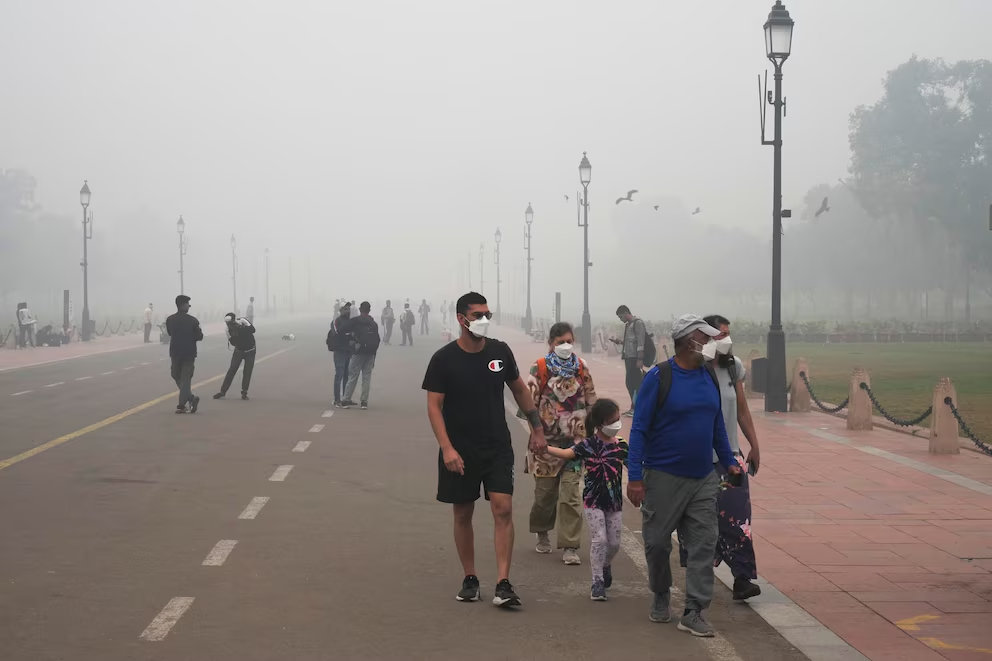
Additionally, a peak of 750 points was recorded, making the capital the most polluted city in the world.
With this phase, non-essential construction and demolition activities are prohibited, as is the use of private vehicles with BS-III gasoline and BS-IV diesel, and the operation of non-essential commercial vehicles.
Furthermore, primary schools must conduct classes online, while telecommuting is recommended to reduce traffic.
Only essential public projects —such as railways, metro, airports, and sanitation— are exempt.
However, these must comply with strict dust and waste controls.
Authorities attributed the increase in pollution to calm winds and stable atmospheric conditions that prevent the dispersal of pollutants.
Criticism after the repression in the demonstrations
After the repression against peaceful protesters, activist Anish Gawande expressed himself on social media.
“When the air quality index reaches 600, the Government beats young mothers and students for fighting for clean air“, he wrote.
Journalist Ashish Srivastava pointed out that “in the national capital there is no right to live, not even to speak for it“.
Meanwhile, opposition leader Rahul Gandhi reminded that “the right to clean air is a fundamental human right“.


