



In the industrial heart of Santiago de Chile, in the commune of Quilicura, a group of artisans keeps alive the craft of working with totora (Schoenoplectus californicus). What was once a cultural and economic practice has now become a key strategy for the environmental health of the San Ignacio canal, declared an urban wetland by the Ministry of the Environment.
Totora, besides being used to make baskets, hats, fans, roofs, and chairs, plays a fundamental ecological role: it filters water pollutants and prevents them from reaching the Pacific Ocean degraded.
Context of contamination and recovery of an urban wetland
For decades, the San Ignacio canal received solid waste, spills, and heavy metals, becoming an illegal dump of more than 10,000 m². However, it continued to function as a biological corridor for species such as huairavos, herons, coipos, and seven colors.
The Illegal Dumps Table identified 87 hotspots in the Metropolitan Region, 55 still active, concentrated in peripheral communes like Quilicura. The pressure of unplanned urbanization and the action of waste mafias worsened the situation.
In 2024, the project Quilicura Clean and Safe removed 180 tons of garbage with community participation. In 2025, Healthy and Dump-Free Canals was launched, a pilot restoration and socio-environmental monitoring plan, within the framework of the Urban Ocean program, which seeks to reduce plastic pollution and connect local care with coastal health.
Totora as phytoremediation
A study by the organization Ciudad Emergente measured the water quality at different points of the canal and found that totora significantly reduces:
- Suspended solids.
- Turbidity.
- Metals such as zinc, aluminum, and manganese.
The plant’s roots absorb and degrade pollutants, acting as a natural phytoremediation system.
Ecological and community management
The management plan respects the cycles of totora and fauna:
- Between September and December, during bird nesting, interventions are minimized.
- Protection zones are delineated to protect species like ducks and pidenes.
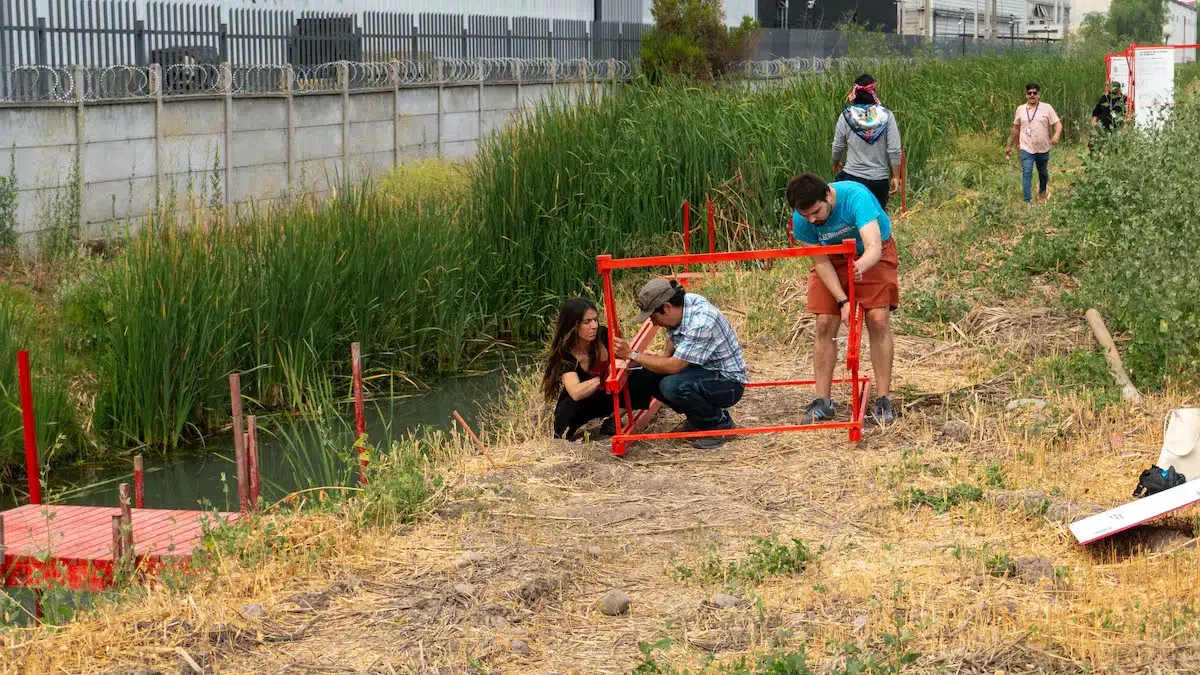
- Walkways and informational panels have been installed to explain the plant’s purifying function and the pruning schedule.
The community actively participates: students walk the walkways, learn the craft of the totora workers, and for the first time associate the word wetland with their neighborhood.
Pride and urban resilience
Surveys reveal pride in the craft, although there is also concern about its invisibility. The artisans of Quilicura no longer only preserve an ancestral technique: they protect an urban ecosystem that connects the city with the ocean.
The experience of Quilicura demonstrates how a traditional craft can transform into an urban resilience strategy. Totora, beyond its cultural and economic value, becomes an ecological tool that purifies water, restores a wetland, and strengthens community identity.
Cover photo: El País



