



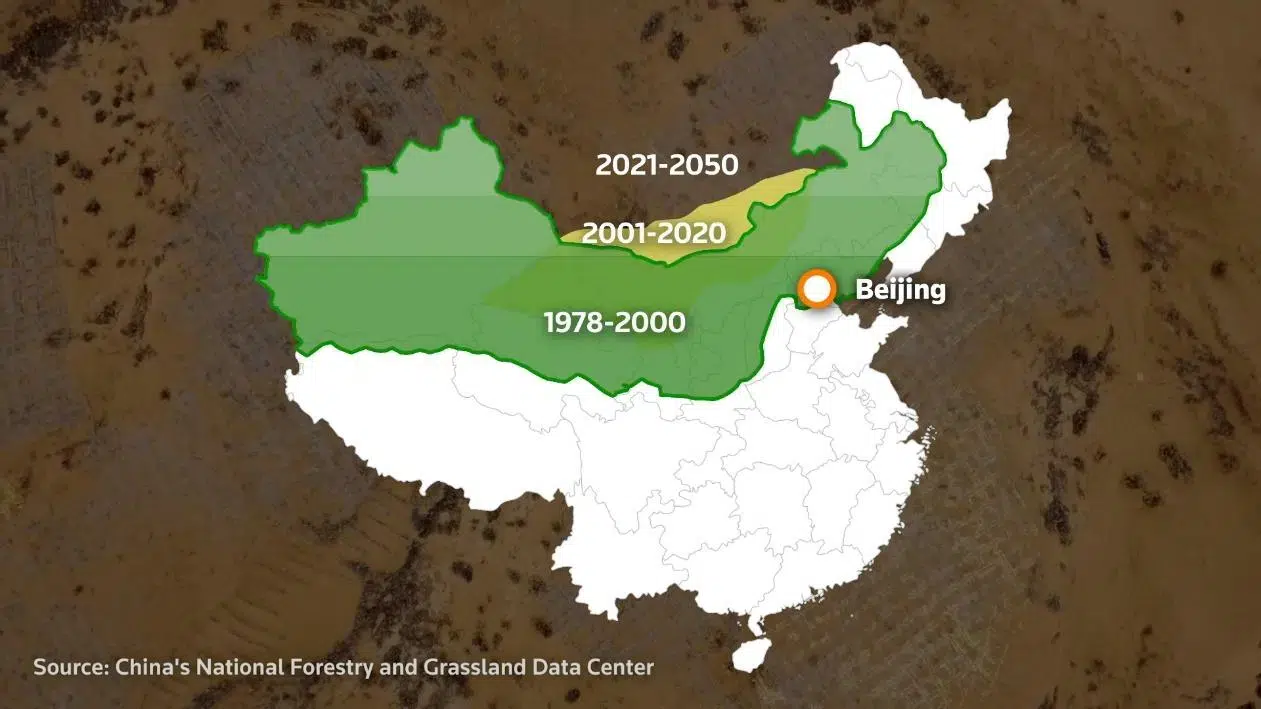
The “Great Green Wall” of China campaign is one of the most ambitious reforestation projects on the planet.
Initiated in the 1970s, it has managed to recover more than 90 million hectares in the arid north of the country, with the aim of halting the expansion of deserts caused by intensive agriculture, grazing, mining, and more recently, climate change.
A continental-scale project
The program has transformed regions like the Kubuqi Desert in Inner Mongolia, where the equivalent of 840,000 football fields was planted. According to a UN report (2015), the initiative generated tens of thousands of jobs and contributed to alleviating poverty.
President Xi Jinping has promoted the project in international forums and committed to increasing forest coverage as part of China’s climate goals.
Between 2016 and 2050, the country plans to plant another 70 million hectares, an area equivalent to that of continental France.
Social impacts: tensions with Mongolian communities
Not everything is beneficial. For Mongolian ethnic communities, which represent 17% of the population of Inner Mongolia, the program has meant restrictions on grazing and the loss of traditional cultural practices.
- Herds of hundreds of sheep were reduced to a few dozen, confined in pens.
- Traditional nomadism has practically disappeared in the last decade.
- Activists denounce forced displacements and loss of connection with the land.
Activist Enghebatu Togochog, exiled in the United States, stated that the herders “are paying the price of repairing habitat degradation, even though they did not cause it.”
Scientific criticisms: reforest at any cost?
Chinese researchers acknowledged in 2017 that the effect of grazing on desertification may have been overestimated, pointing out that mining, intensive agriculture, and climate change are more determining factors.
Experts warn that:
- The use of non-native species or high water consumption species can deplete aquifers and further degrade the soil.
- Deserts fulfill key ecological functions, such as water conservation and biodiversity, so it is not always necessary to convert them into forests.
Balance: between restoration and social transformation
The Great Green Wall is a project that combines environmental and economic successes with social and cultural controversies. It has contributed to:
- Mitigating desertification and climate change.
- Generating employment and new economic opportunities.
- Increasing vegetation coverage and improving degraded ecosystems.
But it has also generated:
- Conflicts with local communities.
- Loss of traditional grazing practices.
- Ecological risks due to the use of inappropriate species.
A future under construction
The Taklamakan Desert, the largest in China, is already surrounded by vegetation. However, the challenge is to ensure that reforestation is sustainable, respecting both the ecology of the deserts and the cultural rights of local communities.
The Great Green Wall is, ultimately, a planetary-scale laboratory on how to tackle desertification and climate change, but also a reminder that ecological restoration must balance nature, economy, and culture.


