



San Luis, Córdoba and La Pampa signed an interprovincial agreement to promote the conservation of the Caldén, the emblematic tree of the Argentine pampas.
This is because, currently, this endemic species faces signs of degradation throughout its territory.
Therefore, the pact establishes mechanisms for joint collaboration to protect the native areas of the caldén, which form a phytogeographic corridor between the provinces.
The agreement bears the signatures of the Secretary of Environment and Sustainable Development of San Luis, Federico Javier Cacace; the Minister of Environment and Circular Economy of Córdoba, Victoria Flores; and the Secretary of Environment and Climate Change of La Pampa, Vanina Basso.
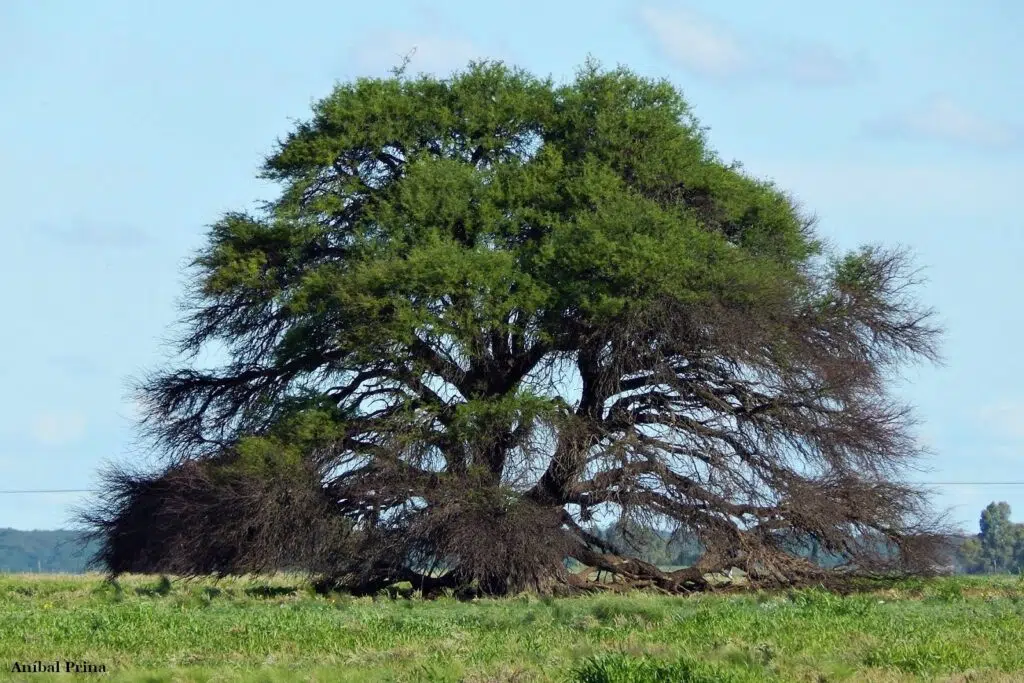
A unique ecosystem at risk
The interprovincial area connects the three provinces through formations of native caldén forest (Neltuma caldenia).
In particular, it is located on the southernmost part of the Espinal Phytogeographic Region, specifically in the Caldén District.
This territory corresponds to one of the five endemic environments of Argentina, which gives special relevance to its conservation.
The landscape is characterized by a mosaic of forests of different physiognomies and states, areas of crops, and natural areas in recovery.
The large extensions feature natural pampas grasslands, interrupted by saline lagoons, saline lowlands, mobile dunes, and sandy soils.
This diversity of environments is influenced by the Chaco, Monte, and Pampas regions.
Joint action strategies to protect the Caldén
The agreement establishes multiple lines of work for the conservation of the Caldén and its associated ecosystem.
Thanks to this, the signing environmental departments will be able to develop various coordinated activities:
- Monitoring the biodiversity of the caldén forest
- Survey of producers and fields
- Declaration of Native Seed Producing Areas (APSN)
- Production of caldén specimens with genetics from the three provinces for ecological restoration
- Placement of road, informational, regulatory, and educational signage
- Collaboration between park rangers and conservation aides
- Execution of communication campaigns to highlight the value of the caldén
- Development of agreements with private owners for certification of good productive practices
- Coordination with local governments and regional universities

The framework of institutional collaboration seeks to unite efforts in programs and projects that recognize the environmental, educational, social, and productive significance of the species.
Environmental services at risk
The caldén ecosystem fulfills essential ecological functions such as hydrological regulation, forage provision, wildlife habitat, and carbon storage, among other environmental services provided by the forest.
Currently, the caldén forests show signs of degradation throughout their extent.
This deterioration is reflected in a process of shrub encroachment that causes damage at the productive and ecological levels due to the high risk of fire.
The collaboration includes coordination with the National University of Río Cuarto, the National University of Córdoba, the Provincial University of Córdoba, the National University of La Pampa, the National Germplasm Bank of Neltuma, and the Rural Societies of the South.
The territory is composed of sets of conservation units, productive lands, human settlements, and transition areas that require coordinated management.
The conservation of the Caldén represents an interprovincial challenge that seeks to reverse the current degradation through concrete actions of monitoring, production, and environmental education.
The agreement sets a precedent for regional cooperation in the protection of unique native ecosystems in Argentina.


