



After containing the fires that ravaged more than 16,000 hectares in Los Alerces National Park, two new outbreaks started in La Tapera. The area is located in Puerto Ciprés, 800 meters from the north coast of the Río Grande–Futaleufú, near Trevelin.
Both outbreaks are 500 meters apart. The larger one has already affected at least four hectares, while the second is burning in a canyon that is difficult to access, complicating ground and aerial work.
Since early morning, 34 park rangers from Trevelin and the Federal Emergency Agency, along with volunteer firefighters, mobilized with boats, motor pumps, and hoses. Later, reinforcements from Chubut and Catamarca joined, in addition to helicopters and water-bombing planes.

Restrictions and prevention in sensitive areas
Due to the operation, navigation was restricted in the southern sector of Lago Futalaufquen and in the Amutuy Quimey Reservoir. Aircraft refill water there, so ensuring safety is a priority.
Additionally, the trails La Balsa and Laguna Toro were closed preventively. This aims to avoid risks for visitors and allow teams to focus efforts on containment.
These measures reflect the fragility of the Andean-Patagonian ecosystem. Each outbreak not only threatens native forests but also watercourses, wildlife, and productive activities linked to nature tourism.
Human action under suspicion and climatic context
The previous fires in the center and north of the park were contained after more than two months, aided by rain and snow. Those started due to lightning storms and highlighted the difficulty of intervening quickly.
In the current case, no storms were recorded in the area. Therefore, authorities are investigating a possible intentional origin and have already filed a criminal complaint with the intervention of the Federal Police.
According to Greenpeace, 95% of fires are linked to human actions, whether due to negligence or intentionality. This statistic reinforces the need for environmental education and stricter controls.
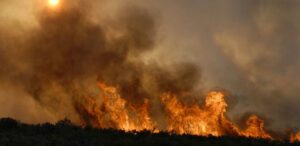
The current situation in the Argentine Patagonia
The northern Patagonian region is experiencing a critical season. The combination of high temperatures, low humidity, and prolonged drought has raised the extreme risk of fires in Chubut and neighboring provinces.
Experts warn that climate change intensifies dry lightning storms and periods of aridity. As a result, the affected area triples each year, and the behavior of the fire becomes more unpredictable.
In parallel, the presence of exotic pines, which are highly flammable, worsens the scenario. Therefore, scientists propose eradicating invasive species and designing evidence-based protocols to decide when and how to intervene.
Lessons and pending challenges
The recent large fires have provided technical lessons for rangers and environmental managers. The speed of the initial attack has been consolidated as the most effective tool to prevent major disasters.
However, the social and ecological cost is high. Families lose homes, animals, and sources of income, while native forests take decades to recover.
In this context, the Argentine Patagonia faces the challenge of strengthening prevention, restoring degraded ecosystems, and promoting a cultural change that prioritizes responsible coexistence with fire.



