



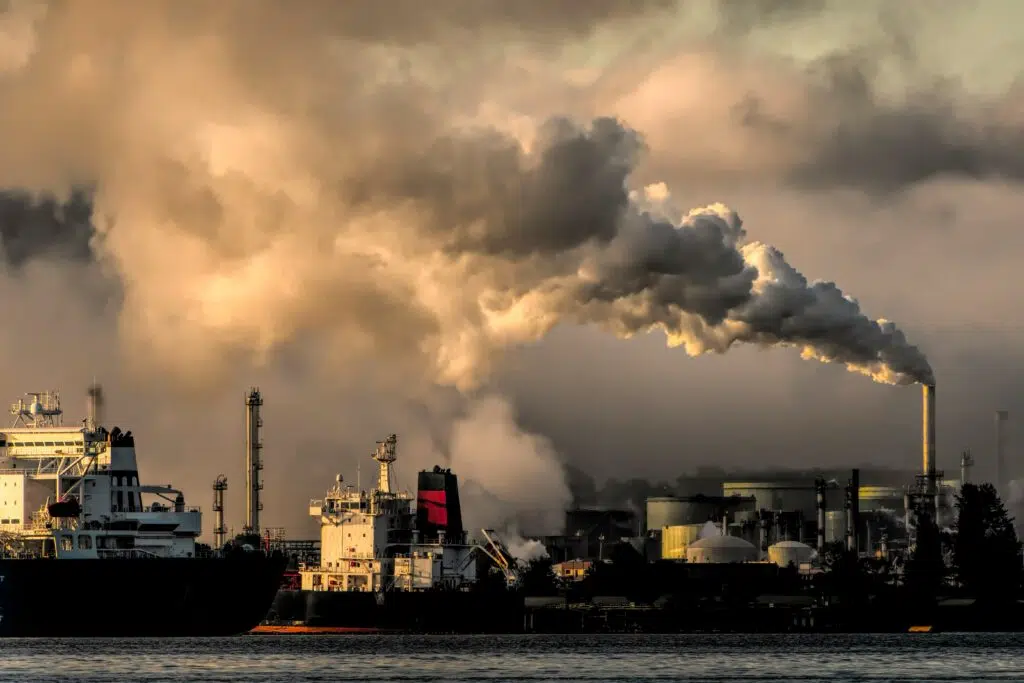
While the goals to limit global warming are far from being met, the use of coal has reached record global levels.
This is indicated by the latest annual report on the State of Climate Action conducted by the National Observatory of Climate Action (ONAC).
Of the 45 climate indicators evaluated, none are close to the goal of limiting global warming to 1.5°C by 2030.
Although coal energy has decreased as a percentage of electricity generation in the last five years, “it is at a historic high due to the increase in total electricity demand,” the document states.
In contrast, the share of solar and wind energy doubled between 2019 and 2024.
This is one of the few positive data points in the report: these two renewables together already account for 15% of global energy generation.

The problem of deforestation
Deforestation “has also deviated worryingly,” according to the authors.
This threat increased from 7.8 million hectares per year in 2021 to 8.1 in 2024.
“Between 2015 and 2024 the world permanently lost a total of 86 Mha of tree cover, an area approximately the size of Pakistan,” the report highlights.
To meet the 2030 targets, it would be necessary to retire about 360 medium-sized coal power plants each year.
Additionally, efforts to stop forest loss would need to be increased ninefold, experts calculate.
“While the progress we need remains possible, achieving it will require much greater and better-coordinated efforts and investments around both proven and emerging solutions,” the report states.
The document was prepared by the High-Level Climate Champions of the UN, Climate Analytics, and the Bezos Earth Fund, among other organizations.
All sectors of the economy must implement “bold systemic transformations” to achieve the temperature goal of the Paris Agreement.
Indicators with insufficient progress: more coal, little public financing, and more
Regarding the indicators analyzed, six indicators show changes “at a promising, though insufficient, pace”:
- electric vehicles (sales and percentage),
- reforestation
- soil fertilization emissions
- ruminant meat productivity
- private climate financing.
Notably, the share of electric vehicles in light vehicle sales has quintupled since 2020, reaching 22%.
However, another 29 indicators are “well below the necessary pace,” while five more are “going in a completely wrong direction”:
- intensity of coal in steel production
- loss in food production
- public financing of fossil fuels
- kilometers traveled by passenger vehicles
- loss of mangroves.
Of the remaining five indicators, there is not even enough data for evaluation.
Finally, the report celebrates that private climate financing has increased and that solar energy is the fastest-growing in history.
Additionally, innovations like green hydrogen are experiencing significant advances, the document highlights.
“However, for every promising advance, there are worrying signs of stagnation or regression,” the report summarizes.
Among the recommendations from the study to achieve these goals, the researchers highlight:
- boosting research and development
- eliminating financing that perpetuates dependence on fossil fuels and funds deforestation
- placing justice and equity at the center of climate action “so that no one is left behind in the transition”



