



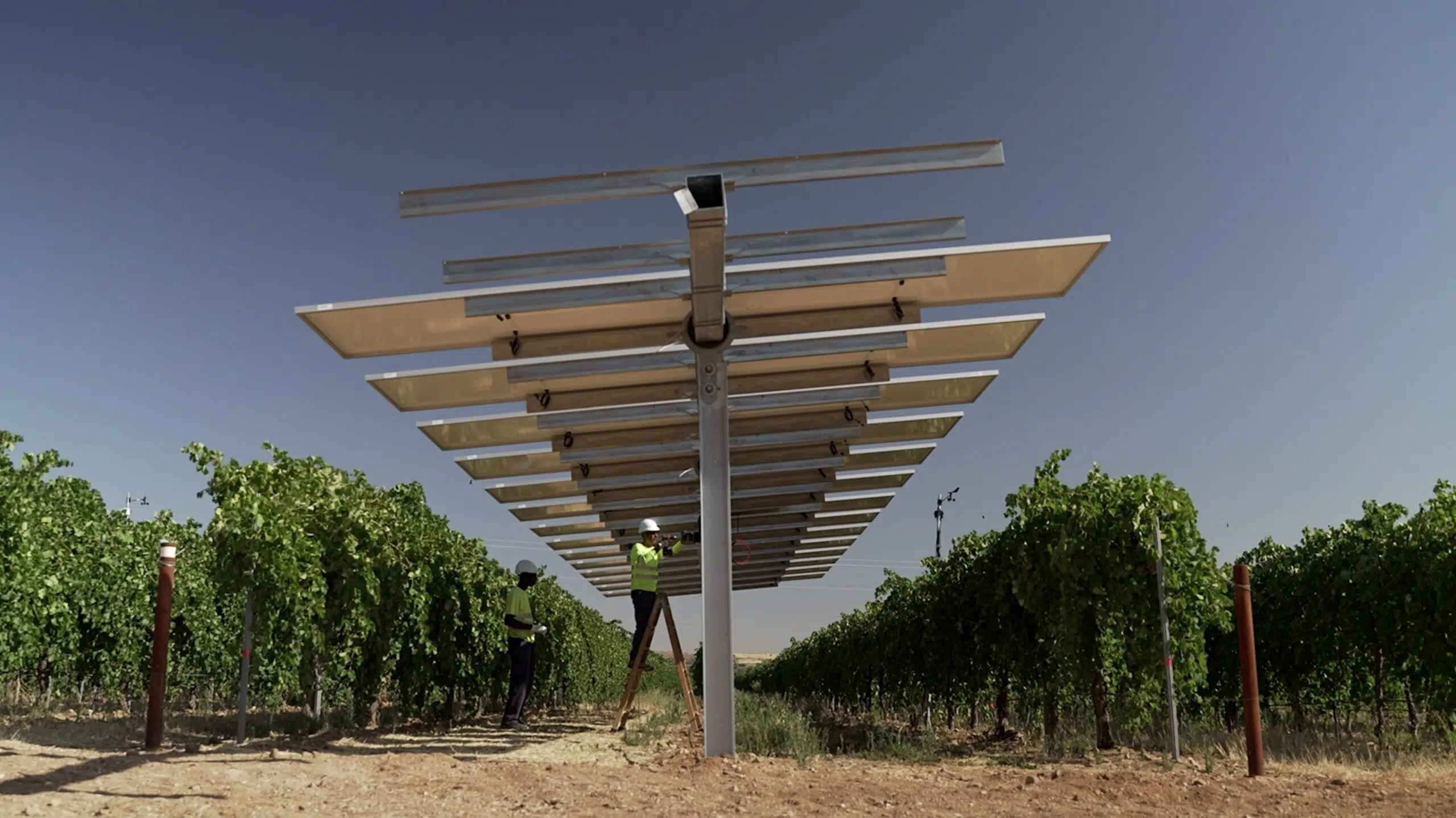
A research team from the University of Jaén (Spain) presented a technology that opens new possibilities for agrivoltaics: solar panels capable of efficiently generating electricity. At the same time, they allow enough light to pass through for crops to maintain their optimal photosynthesis cycle.
The challenge of massive photovoltaics
- The European Union aims for 30% of its energy to come from renewables by 2030 and to achieve climate neutrality by 2050.
- Photovoltaics are rapidly expanding thanks to price drops due to China’s overproduction.
- The problem: panels occupy large areas and create conflicts with farmland.
- Agrivoltaics emerges as a solution, combining solar energy with agriculture, beekeeping, and livestock.
The innovation from Jaén
In a study published in Science Direct, the researchers detail a system named RearCPVbif (Rear Concentrator Photovoltaic bifacial).
- Unlike conventional semitransparent panels (STPV), this technology concentrates and redirects reflected light to the back of bifacial cells.
- The result: a substantial increase in electricity production without reducing the optical transparency needed for crops.
- The transparency factor reaches 60%, considered adequate for most horticultural crops.
Key technical parameters
The researchers considered two indicators:
- Average visible transmittance: the amount of visible light that passes through the panel.
- Average photosynthetic transmittance: useful light for photosynthesis that reaches the plants.
Previous studies indicate that the minimum value for crops to function normally should be around 60%, a figure reached by the new technology.
Status of “transparent” panels
The photovoltaic industry is working on two approaches:
- Non-wavelength-selective panels: absorb much of the solar spectrum, with insufficient transparency.
- Wavelength-selective panels: absorb ultraviolet and near-infrared radiation, allowing the visible light needed by plants to pass through.
The Jaén system differentiates itself by incorporating rear optical concentrators, optimizing both electricity generation and transparency.
Agricultural viability
The study also evaluated the thermal behavior:
- The temperature of the cells remained below 70 °C.
- This prevents the “greenhouse” effect that could alter crop growth patterns.
The innovation from the University of Jaén demonstrates that it is possible to expand solar energy without compromising agricultural production.
With a design that combines electrical efficiency and optical transparency, the RearCPVbif panels represent a key advancement for agrivoltaics and for the energy transition towards a more sustainable model.



