



At almost 4,000 meters high, the village of Sakti in the Ladakh region faces extreme conditions for agriculture. The scarcity of rainfall and low temperatures make this sector of the Himalayas a true mountain desert in India, where the availability of water determines the survival of rural communities.
However, climate change has further worsened the situation. Over the past decades, numerous small and low-altitude glaciers that supplied water to the crops have started to disappear. As a result, farmers have seen their water reserves reduced just at the most critical time of the year: the start of the planting season.
In response to this situation, residents of Sakti and other localities in Ladakh have promoted innovative solutions to store water during the winter and release it gradually in the spring. This led to the emergence of the first artificial glacier projects, a strategy that today is seen as a key tool for climate adaptation in high mountain regions.
From ice stupas to automated systems
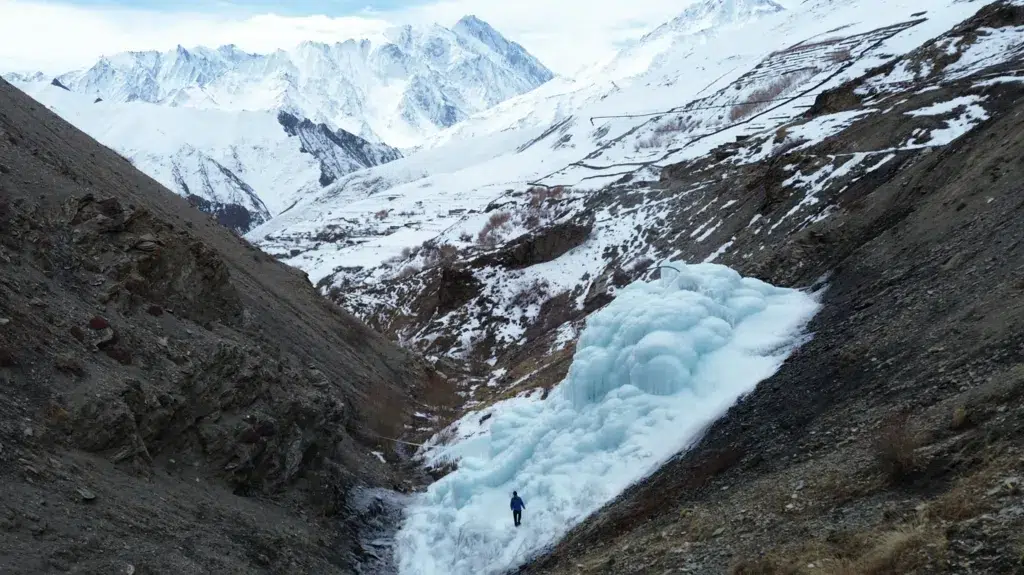
The first experiences involved the construction of huge ice towers known as ice stupas. The method used water channeled from elevated sections of the mountains, which was sprayed outdoors during the winter to freeze and form solid deposits.
However, the system presented significant operational difficulties. The extreme temperatures, which often dropped below 20 or 30 degrees below zero, caused pipes to freeze, resulting in breakages and forcing farmers to carry out constant maintenance tasks.
Moreover, the ice production was inefficient. During warmer days, the circulating water accelerated the melting of part of the accumulated ice, reducing the system’s storage capacity.
For this reason, in recent years a new technology developed jointly by local authorities and the company Acres of Ice has been implemented. The system, called Automated Ice Reservoir (AIR), incorporates sensors, weather stations, solar energy, and computerized controls to optimize the freezing process.
How artificial ice pyramids are formed
The so-called ice pyramids or stupas are created by taking advantage of the low winter temperatures and gravity. Water from higher mountain areas is channeled through pipes to strategic points in the valley.
Subsequently, the liquid is released under pressure through a vertical nozzle, creating a kind of giant fountain. Upon contact with the extremely cold air, the droplets freeze immediately and accumulate, forming conical structures that can reach several meters in height.
In modern AIR systems, sensors continuously monitor the temperature, humidity, and wind. Thanks to this, water is released at precise intervals to maximize ice formation and avoid unnecessary losses.
As a result, these pyramids function as temporary reservoirs that slowly release water during the spring when agricultural needs are greater and natural sources are still frozen.
Environmental benefits for mountain communities
The new ice reservoirs are helping to improve the water security of numerous villages in Ladakh. By having water during the planting months, farmers can sustain the production of wheat, peas, and potatoes under increasingly difficult conditions.
Additionally, various local testimonies indicate that the presence of these reservoirs favors the recharge of groundwater and the recovery of springs, strengthening the resilience of ecosystems against global warming.
Moreover, the initiative helps to reduce rural exodus. The availability of water allows for the maintenance of agricultural activity and provides greater opportunities for new generations to remain in their communities.
Meanwhile, during the winter of 2025, ten AIR projects were developed in various parts of Ladakh. The goal now is to multiply the number of artificial glaciers to face a future where water conservation will be increasingly crucial for life in the Himalayas.



