



In northwest China, researchers from the Chinese Academy of Sciences have developed a method capable of transforming desert sand into a fertile soil base in just 10 to 16 months.
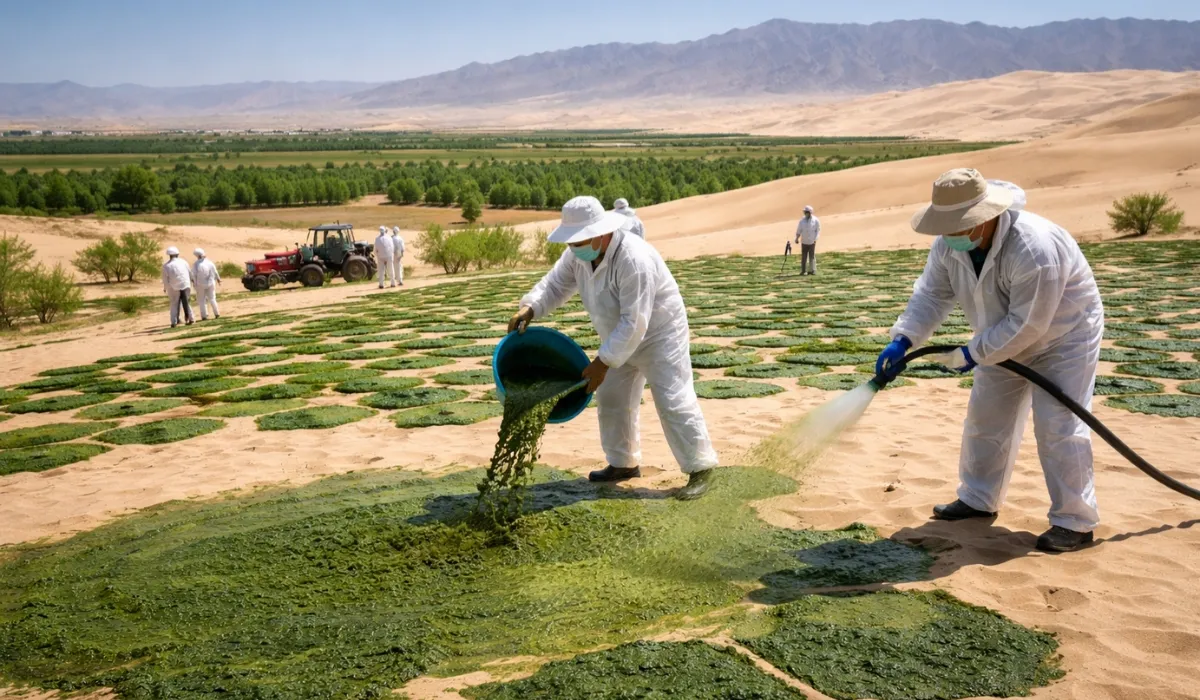
The procedure involves applying laboratory-cultivated cyanobacteria on straw boards arranged in a checkerboard pattern. Over time, these bacteria form a biological crust that stabilizes the sand and allows subsequent ecological processes to begin.
The Role of Cyanobacteria
Cyanobacteria, present on Earth for 3.5 billion years, are capable of:
- Capturing carbon dioxide and transforming it into organic matter.
- Fixing atmospheric nitrogen into usable forms.
- Secreting sticky sugars that bind sand grains and form a cohesive film.
Once established, they create a living first layer that reduces sand mobility, retains nutrients, and facilitates seedling germination.
Observed Results
During the first year of application:
- The treated surface began to retain nutrients like nitrogen and phosphorus.
- Water evaporation was reduced, maintaining moisture after brief rains.
- Lichens and mosses appeared, reinforcing wind resistance and creating humid microspaces.
In laboratory tests, an artificial crust reduced soil loss by wind by more than 90%, decreasing dust storms and improving the durability of nearby roads.
Limitations and Challenges
The biological crust is wind-resistant but vulnerable to human activity: footsteps, tires, or overgrazing can destroy it. Additionally:
- Not all dunes require intervention.
- Local strains are often more effective than imported ones.
- Desertification also depends on factors like water use and grazing pressure.
Therefore, the method must be applied with long-term criteria and protection.
Ecological Potential
The introduction of cyanobacteria shortens processes that would normally take decades to consolidate, reducing them to a few years. While it does not immediately turn sand into agricultural land, it does create a living base capable of supporting vegetation and recovering lost ecological functions.
Combined with responsible grazing management, selection of adapted plants, and soil protection, this approach can be integrated into programs for the restoration of degraded lands and serve as a preventive tool against desertification.
The Chinese method demonstrates that biotechnology applied to microorganisms can offer realistic solutions to stabilize soils and recover ecosystems in arid areas. It is not a total solution, but it is a firm step towards ecological restoration and the reduction of dust storms in desert regions.



