



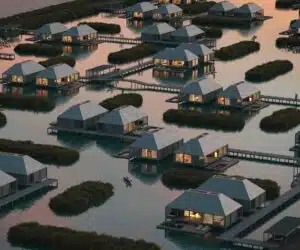
The Danish architecture firm MAST developed a revolutionary system for building floating houses. Named “Land on Water”, this technology aims to offer an alternative flexible and sustainable to traditional building methods on bodies of water.
MAST’s design is based on a system of modular containers made of reinforced recycled plastic. These can be filled with different floating materials, such as watertight plastic containers, mimicking the structure of gabions used in land construction. Once assembled, these floaters provide the necessary stability to raise houses, garages, pools, or even entire neighborhoods over the water.
One of the main attractions of the project is its ease of transportation and installation. The modules can be shipped anywhere in the world and assembled on-site, reducing logistical costs and carbon footprint. Furthermore, unlike traditional systems that use concrete filled with polystyrene, “Land on Water” proposes a more ecological alternative by avoiding the use of polluting materials.
According to Marshall Blecher, co-founder of MAST, this system could encourage the development of entire communities over the water, expanding urbanization possibilities in areas vulnerable to floods or with a scarcity of habitable land.
Challenges and Regulations
Despite its potential, building on the water faces various legal and environmental challenges. In many countries, the occupation of water bodies is regulated by standards that protect water quality and the rights of use of aquatic spaces. However, the innovative nature of “Land on Water” could generate a specific regulatory framework that facilitates its implementation.
A key aspect of this proposal is its positive impact on marine biodiversity. Submerged structures can act as artificial reefs, promoting the growth of mollusks, crustaceans, and algae. Blecher emphasizes that, unlike steel and concrete, which require chemical treatments to prevent fouling, the plastic modules of “Land on Water” can become natural shelters for aquatic fauna.
MAST is already working on a prototype that will be presented at the UIA World Architects Congress in Copenhagen. With this innovation, Blecher and his team aim to demonstrate that floating houses can be a viable solution for urban growth, offering safety against natural disasters and promoting environmentally friendly development. In a world where climate change poses increasing challenges, floating architecture could become a key alternative for future habitation.

Self-sufficient Housing: the ‘habitable power plant’ that generates its energy
Designed with a focus on energy efficiency, the house features a roof equipped with 37 solar panels, a 20 kWh battery, and an air source heat pump. Its structure, built with recycled copper, acts as thermal insulation: blocking solar heat in summer and harnessing it in winter.
Additionally, its angular shape allows for efficient lighting and prevents overheating without the need for air conditioning. Due to its cubic design, it optimizes thermal insulation and minimizes material waste.
Source: BEonloop.
Have you visited our YouTube channel yet? Subscribe now!



