



In a context where bees are increasingly threatened by climate change, pesticide use, and habitat loss, a 13-year-old boy brought an innovative solution. He 3D printed a beehive.
Oliver Taylor, from the UK, designed and built a modular beehive in his own room. It is capable of hosting between 30,000 and 40,000 honey-producing bees.
This sustainable and low-cost development allows bees to enter and exit freely to the outside, through a system attached to the window. It is similar to a portable fan or compact air conditioner.
Each hexagonal unit of the modular system is designed to facilitate cleaning, preserve honey, and ensure the well-being of the bees.
A beehive inspired by commercial models, improved
Inspired by a commercial model inaccessible due to its high price, Oliver replicated the structure and improved it by incorporating a double security gate system. He was inspired by watertight compartments of submarines.
This solution prevents massive leaks of bees when adding new modules, one of the issues of previous designs.
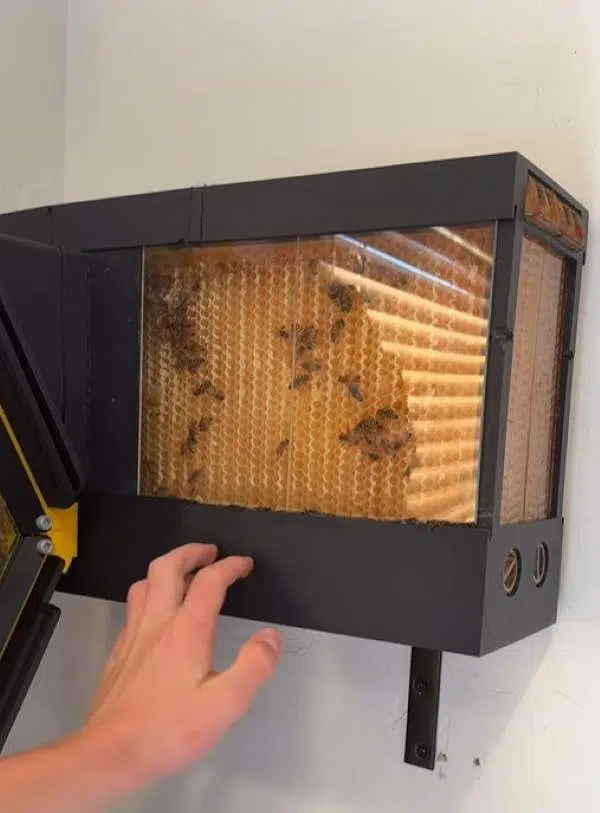 The beehive invented by Taylor. (Photo: redes-Bryan Mark Taylor).
The young man used an open-source Prusa 3D printer and free software like Blender to design his beehive, built with accessible and reusable materials.
He started with an initial kit of a bee farm that contained 12,000 bees and a queen, and managed to expand the population to over 30,000 thanks to a feeding system with sugary water.
Urban and stress-free beekeeping
In addition to facilitating home honey production without the need to open the hive or intervene in the internal structure, Taylor plans to develop an extraction system. This way, adding new modules to increase the bee population.
His design also reduces stress on insects, by preventing them from spending energy building combs, allowing them to focus on pollination and honey production.
 Endangered bees.
The 3D printed modular beehive represents a great advance for urban and educational beekeeping, as it can be easily reproduced by other people in their homes, schools, or communities.
Due to its low cost, efficiency, and accessibility, it is also a useful tool to raise awareness about the importance of pollinators in urban and rural environments.
An accessible, educational, and replicable invention
These types of technological solutions bring bee protection into everyday life. This allows combining science, sustainable design, and environmental education to address the challenges of current biodiversity.
Oliver Taylor’s proposal is not only a display of youthful creativity in the service of the planet, but also an invitation to rethink the role of technology in biodiversity conservation.



