



In a context of sustained growth of the **global seaweed market**, which reached USD 8.850 million in 2024 and is projected to exceed USD 17.000 million by 2032, [Puerto San Julián](https://noticiasambientales.com/ciencia/santa-cruz-avanza-en-san-julian-el-primer-proyecto-de-siembra-de-algas-del-pais/) becomes a protagonist with the **first pilot project of giant seaweed cultivation in Argentina**.
The initiative, led by the [Por el Mar Foundation](https://www.porelmar.org/), proposes a form of **sustainable, innovative, and locally impactful production**.
## From gastronomy to industry: kelp as a strategic resource
Until recently, **seaweeds** were mainly associated with cooking. Today, their productive potential places them at the center of an **industrial and ecological revolution**.
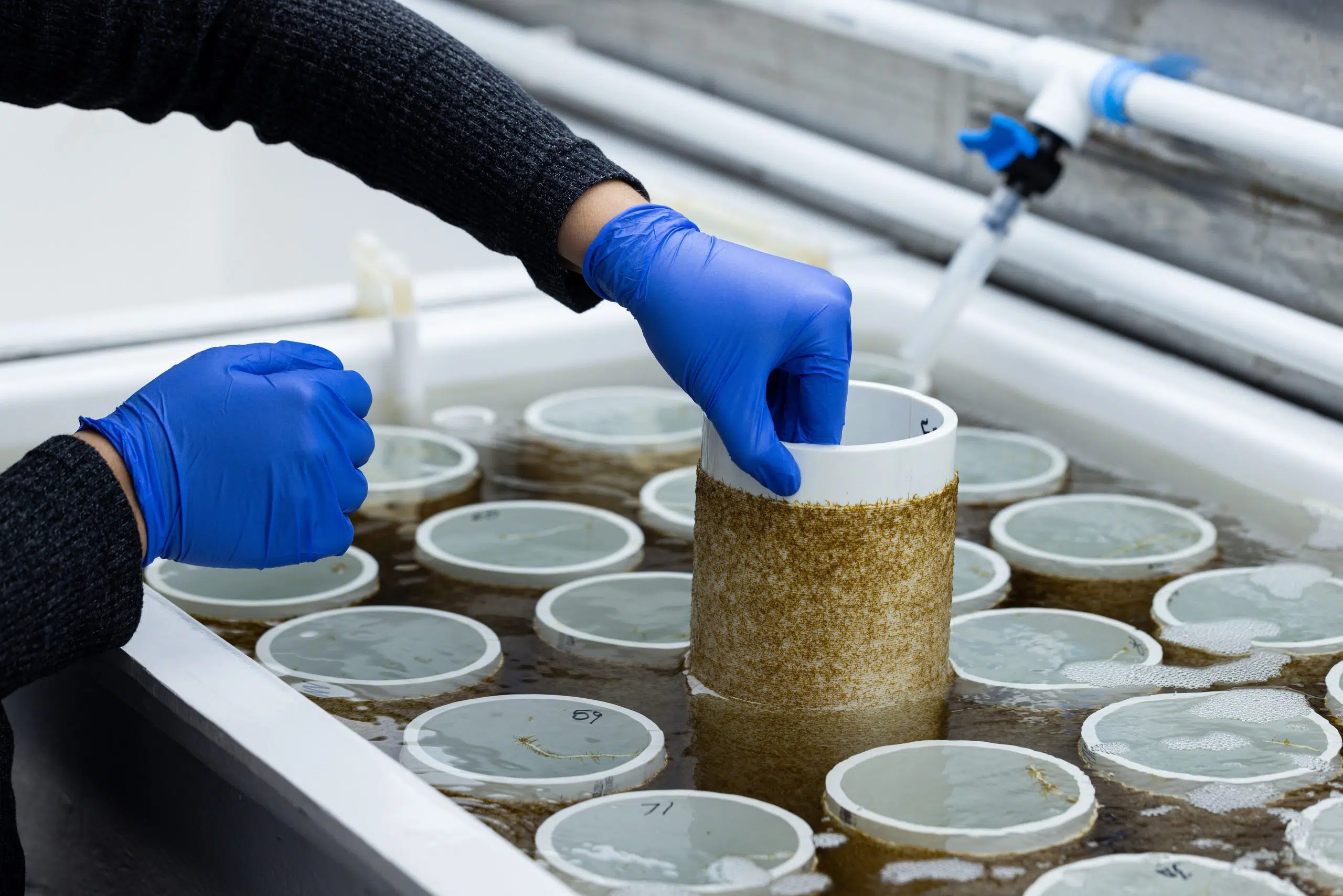
The [kelp (Macrocystis pyrifera)](https://noticiasambientales.com/animales/sorprendente-hallazgo-en-el-mar-las-orcas-crean-herramientas-con-algas-para-acicalarse-entre-si/), cultivated on the Santa Cruz coast, can grow up to **50 cm per day**, **capture carbon dioxide**, **improve water quality**, and **serve as a shelter for marine species**.
Its applications range from **agricultural biostimulants**, **foods**, **cosmetics**, and **nutritional supplements**, to **biodegradable packaging**, **fabrics**, and **construction materials**. The **value chain** is structured in three stages: **production and harvesting**, **primary processing**, and **transformation into final products**.
## Regenerative planting and international cooperation
The Por el Mar Foundation works in partnership with **GreenWave**, a U.S. organization that promotes **regenerative planting** and articulates a **global network of ocean farmers**. “We are at a key stage: spring growth. We planted in May and now the development in the sea begins,” explains **Mariano Bertinat**, project coordinator.
Minister **Nadia Ricci**, during a recent visit, highlighted that these initiatives allow to **diversify the productive matrix**, **generate genuine employment**, and **add innovation from the territory**. “It is not a prohibitive scheme, but productive. We will use this scientific work to enhance local entrepreneurs,” she stated.
## Santa Cruz and its underwater forests: natural heritage and economic opportunity
In several points along the Santa Cruz coast, there are **virgin forests of macroalgae**, considered among the last on the planet.
Their conservation is a priority not only for **environmentalists** but also for the **fishing industry**, which depends on these ecosystems to maintain **biodiversity and marine productivity**.
## A blue economy with local identity
In addition to its industrial value, kelp emerges as a **sustainable solution** to issues such as **food security**, **plastic pollution**, and **climate change**. In many countries, coastal algae production is vital for **rural communities**, and numerous initiatives are **led by women**, generating **positive social impact**.
“We have a province rich in natural resources, but many of them are finite. We want to develop **renewable productive alternatives**, creating **lasting jobs** through **innovation and the development of local capacities**,” Bertinat states.
## The future grows under the sea
The project in Puerto San Julián opens a concrete door towards a **blue economy with a Santa Cruz identity**, where **sustainable production** and **environmental protection** are integrated into the same strategy.
Investing in seaweeds is investing in a **cleaner, fairer, and more resilient future**, where **science, community, market, and sea** grow together.



