



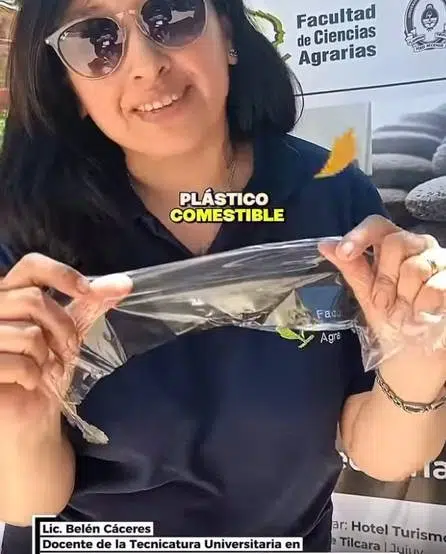
A practical experience carried out in the University Technical Degree in Transformation of Agricultural Production, taught by the Faculty of Agricultural Sciences of the National University of Jujuy (Unju) in Tilcara, went viral on social media by showcasing the creation of an “edible bioplastic” developed by students along with their teachers.
The product, made with simple and environmentally friendly ingredients, sparked great interest and debate, reaching more than 101,000 views in a few hours from the Faculty’s institutional accounts.
How the idea was born
The proposal arose in the Packaging, Storage, and Distribution course, led by food scientist Carolina Singh, where students work on sustainable packaging. Teacher Belén Cáceres, responsible for the practices, told the portal El Tribuno that the initiative was born out of curiosity:
“We saw a video about edible bioplastics and thought: why not try it ourselves? Since the course addresses packaging topics and the students create products, we decided to experiment with materials that do not harm the planet.”
Simple ingredients to create the “edible bioplastic”
With unflavored gelatin, edible glycerin, and water, the students achieved a flexible and degradable sheet, capable of wrapping food. The experience was enriching: the students proposed variations and even thought about incorporating natural pigments and flavors in future tests.
During a career outreach day in Tilcara, the demonstration generated a great impact on social media. Comments ranged from surprise, curiosity about the taste, and questions about its real use, which motivated the team to continue researching.
A process accelerated by the Quebrada’s climate
Although the project is in its initial stage, the results were encouraging. Cáceres explained that the dry climate of the Quebrada de Humahuaca accelerated the drying of the material:
“In just 40 minutes we could already see the texture the film would take, when normally the process requires 24 hours.”
The teacher emphasized that they still need to conduct tests on degradation, resistance, and preservation, but the path is promising.
Regional identity and contribution from local producers
The innovation is not limited to the technical. Many students are local producers and contribute knowledge about natural resources of the region, such as native flowers and pigments.
“They teach us a lot. They know which plants give color, which products can be used, and that inspires us to think of a film with regional identity, made with raw materials from the area,” Cáceres noted.
Comparison with industrial plastics
During the exhibition, the students compared their creation with polyethylene, the most common plastic in industrial packaging, highlighting the ecological potential of the proposal.
The experience also allowed the career in Tilcara to be showcased and demonstrated that sustainable innovations can be generated from Jujuy.
Practical and sustainable education
The University Technical Degree in Transformation of Agricultural Production began in 2021 with the aim of adding value to rural production and training technicians capable of intervening in sustainable processes.
Its modality combines theory and practice, alternating virtual and in-person weeks, which facilitates the participation of rural producers and entrepreneurs. It is currently also taught in Abra Pampa, with a format of 75% virtual and 25% in-person, expanding access to students from other localities.
The program already has first graduates, some working alongside local producers to apply the knowledge acquired.
Next steps and open call
The project will continue with new tests to measure the degradation of the material, its resistance, and the incorporation of local ingredients. Additionally, they plan to apply the knowledge to other uses, such as soil covers or protective biopellicles for fresh foods.
The pre-registrations for the 2026 cycle are already open online until March 6. In-person registration will take place in two stages: from November 3 to December 16, 2025 and from February 3 to March 6, 2026.
“We want more people to be encouraged to study, to innovate locally. This program shows that from Jujuy, it is also possible to research, create, and transform, with respect for the environment and pride in our resources,” Cáceres concluded.
Cover photo: El Tribuno



